




Strategy tools for content marketing: the "FISH model" and the "Content RADAR"

Over the weekend, I finished writing the documentation for two strategy tools I developed, which I’ve been using for some time now in my consulting projects, training sessions, and as a lecturer. And every time, people are thrilled. Here, however, “tool” doesn’t refer to just any piece of software, but rather to a specific method. Specifically, these are the “FISH Model” and the “Content RADAR.” The goal is the same for both tools: to create content in a more structured and methodical way. On the one hand, this provides clear guidance and thus a great deal of confidence during the planning phase; on the other hand, it lays a solid foundation for later performance analysis. I hope I can convey the idea here just as well as I do “in person.”
One problem I repeatedly observe with clients (but also with many agencies) is that they come up with lots of ideas for content they could create. Those who are good at it manage to not only define post types (e.g., Facebook posts, blog articles, or Instagram images), but also topics the content into topics . And those who are really good also define personas, which are researched and described in varying degrees of detail. But when it comes to implementation, one thing usually counts above all else: your own gut feeling and what you "kind of like" afterwards. At the latest when it comes to approval: because the client or supervisor has no other criteria by which to judge the quality of the content.
Here are two key charts for both strategy tools: on the left is the FISH model, and on the right is the Content RADAR:
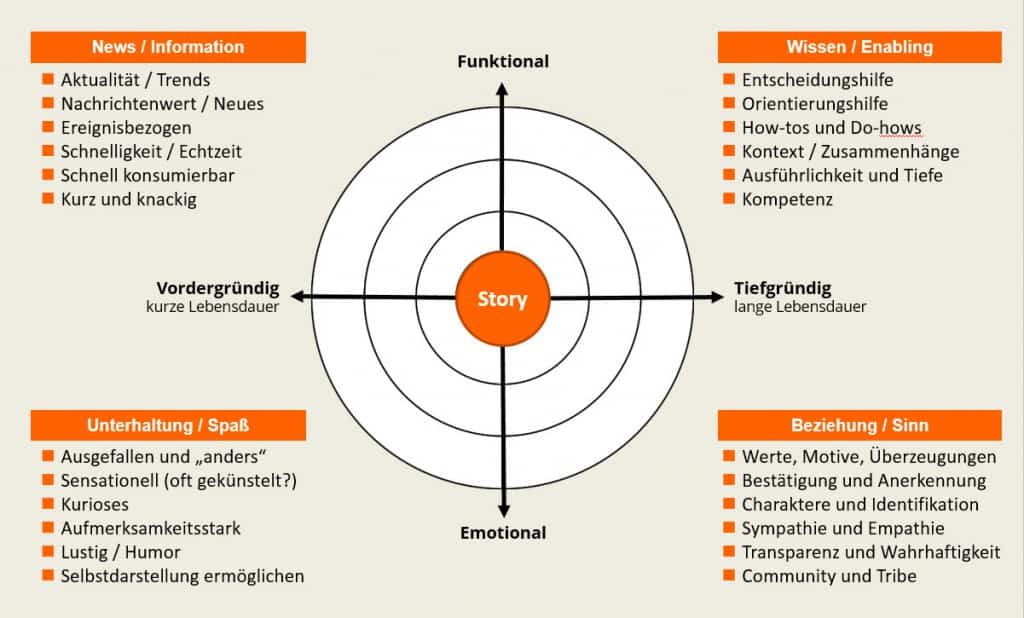
The four benefit dimensions of content
The FISH model
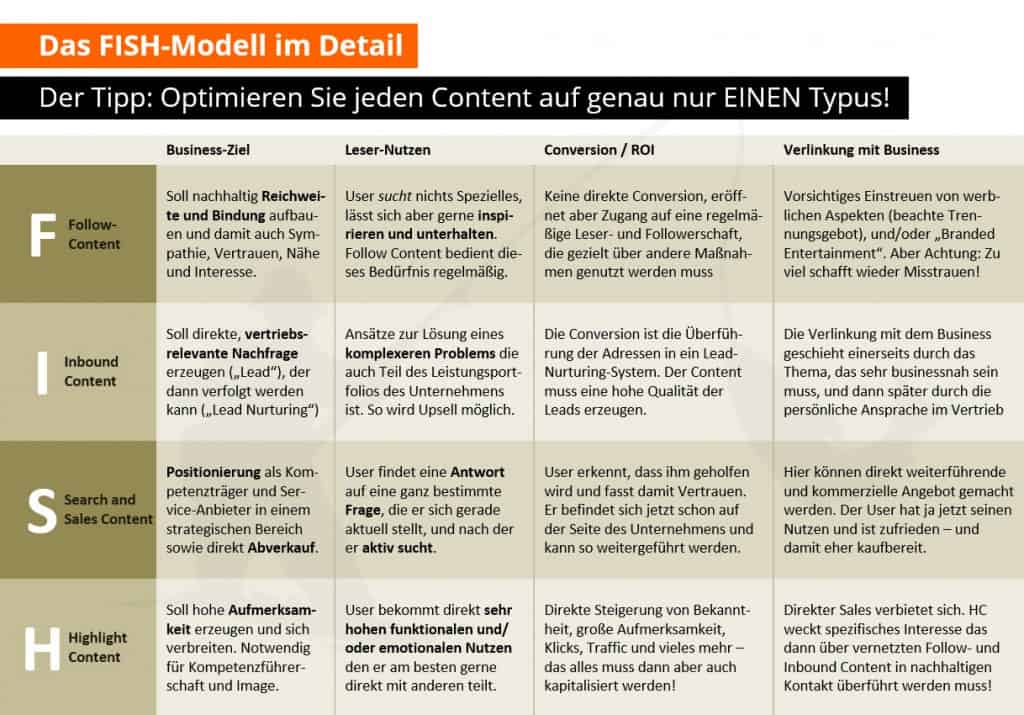
The basic idea behind the FISH model is that content must fulfill certain tasks: both for the company (which has to finance it) and for the consumer (who would otherwise not read it). However, mixing tasks can interfere with each other, e.g. "generating leads" and "building trust". The more clearly content pursues each individual task, the better it will perform that task.
“Strategic content marketing”means building a system in which individual pieces of content work together as a team, following a specific strategy and with assigned roles-but always in unison. The FISH model defines various types of content, each designed to fulfill different functions and therefore requiring different approaches.
The Content RADAR
A second model is the Content RADAR, which adds a second dimension, so to speak. While the FISH model focuses primarily on the benefits for the company, the Content RADAR represents the benefits for the reader. If you combine both models, this results in a very precise blueprint for the implementation of the content - and that is an ingenious orientation aid.
So here are the slides first, with explanations below.
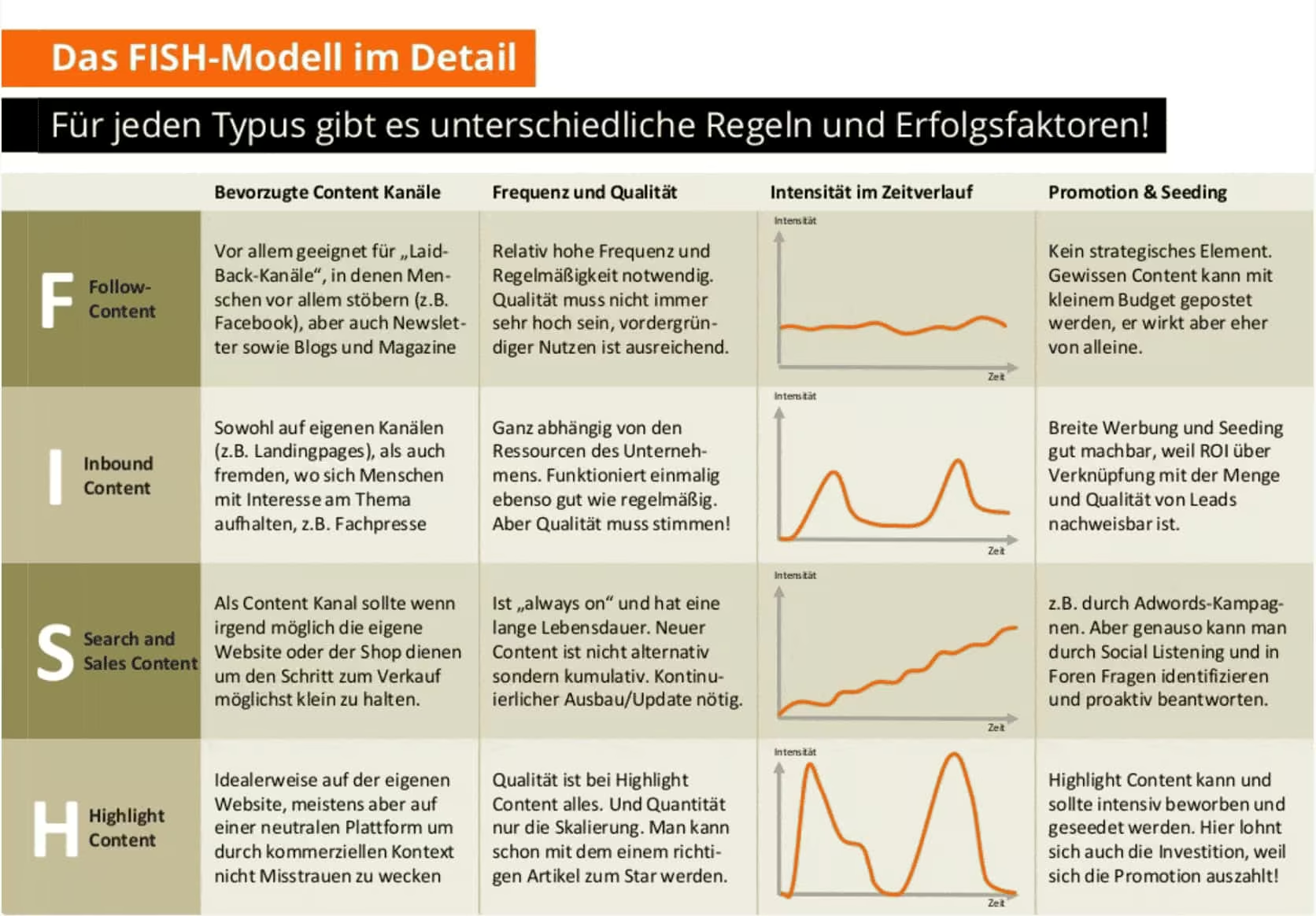
The FISH model in detail
The FISH model is a tool for the strategic categorization of content types. The categories follow, inbound, search, and highlight content describe the benefits you generate for your company by creating value for your target groups.
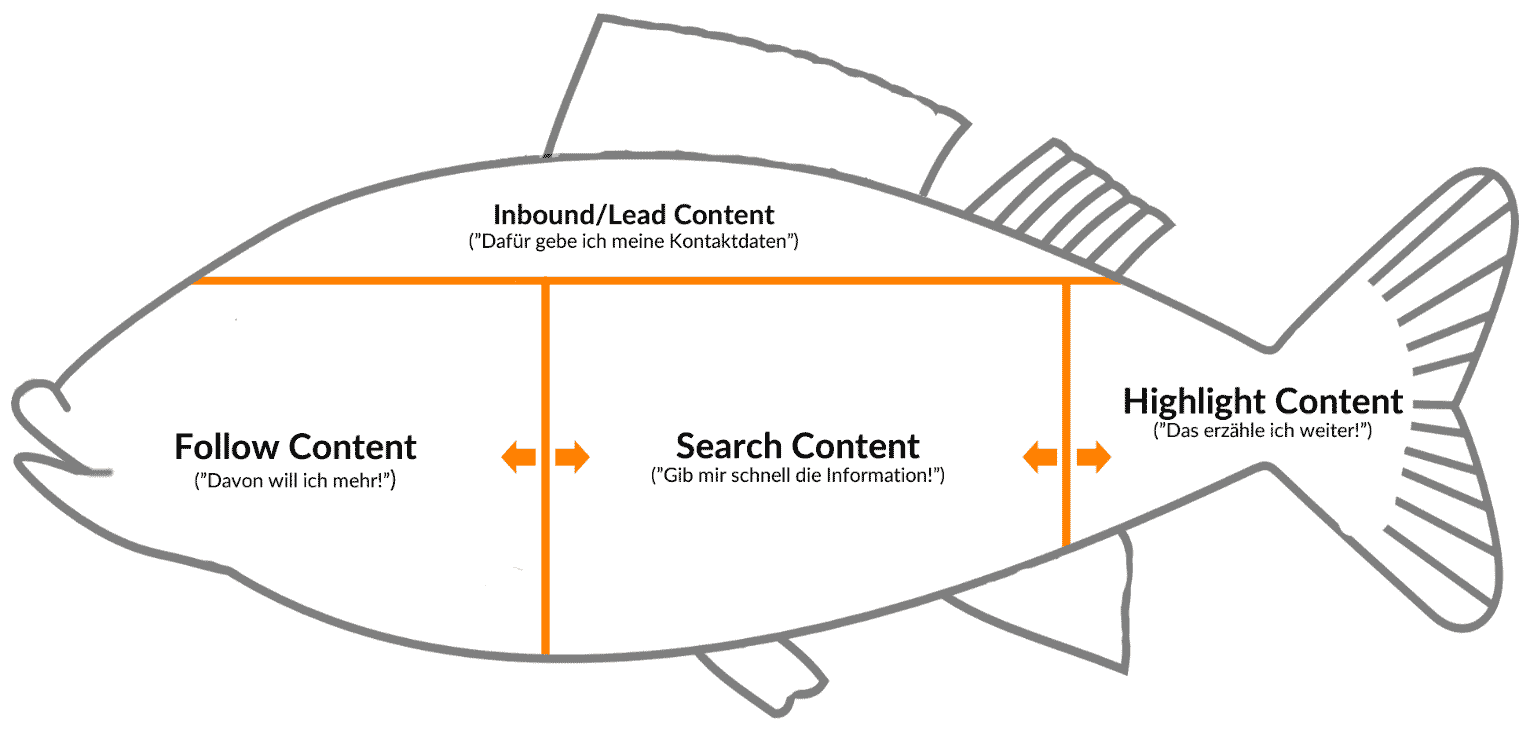
Follow content is content that is designed to interest people so much that they want more of it. This allows you to retain them and gain "access" to them. Lars Cords, Chief Content Officer of the Scholz & Friends Group, refers to this type of content as "Scheherazade content." Scheherazade, the daughter of the vizier from "One Thousand and One Nights," managed to save her head day after day because the Persian king wanted to hear the continuation of her story. Columns, series, and storytelling are suitable for this purpose, as are images, which also play an important role here.
The key here is to offer many ways for the customer to subscribe to the content, for example via a "Like" on Facebook or a subscription to a newsletter or a "Follow" on Twitter. This is particularly important for building reach, which we will come back to in part three. This type of content should be published on channels where people are in "consumption mode", especially on Facebook or in a "magazine".
Inbound content. This involves offering very elaborate, exclusive content with high utility value. However, the main aim is to get the reader to request the content and leave their email address in return. This generates a "lead" that your sales department can use later. Studies or white papers are very well suited for this, topic the topic must also lend itself to this. Inbound content plays a very different role for different companies: for some, especially sales-oriented ones, it is indispensable. For others, more image-conscious ones, it plays hardly any role.
And it has something in common with all the others: it should be easy to find in search engines like "search content", it should be attention-grabbing like "highlight content", and ideally it should make you want more like "follow content"
Search and sales content aims to provide answers to questions that have actually been asked. The benefit for your company is that you will be found and build your reputation. Avoid answering questions that no one has asked! Unlike follow-up content, storytelling tends to be more of a hindrance here, and images generally play a secondary role.
Above all, search content must be optimized for keywords, both for Google and for the reader, who must quickly recognize that this is where they will find the answer to the question or information they are looking for. In contrast to follow or highlight content, the headline must also be factual and informative rather than creative. And remember: search content is not just for Google. People also search in many other places, for example YouTube, Slideshare, Amazon and also on your website!
Highlight content is there to attract attention. It should inspire your target groups, but the benefit for you is that they will share the content! These are the big campaigns, the viral videos, and they should also be promoted more heavily. They are usually very expensive, both in terms of production and seeding costs, but they are very helpful in building a large reach.
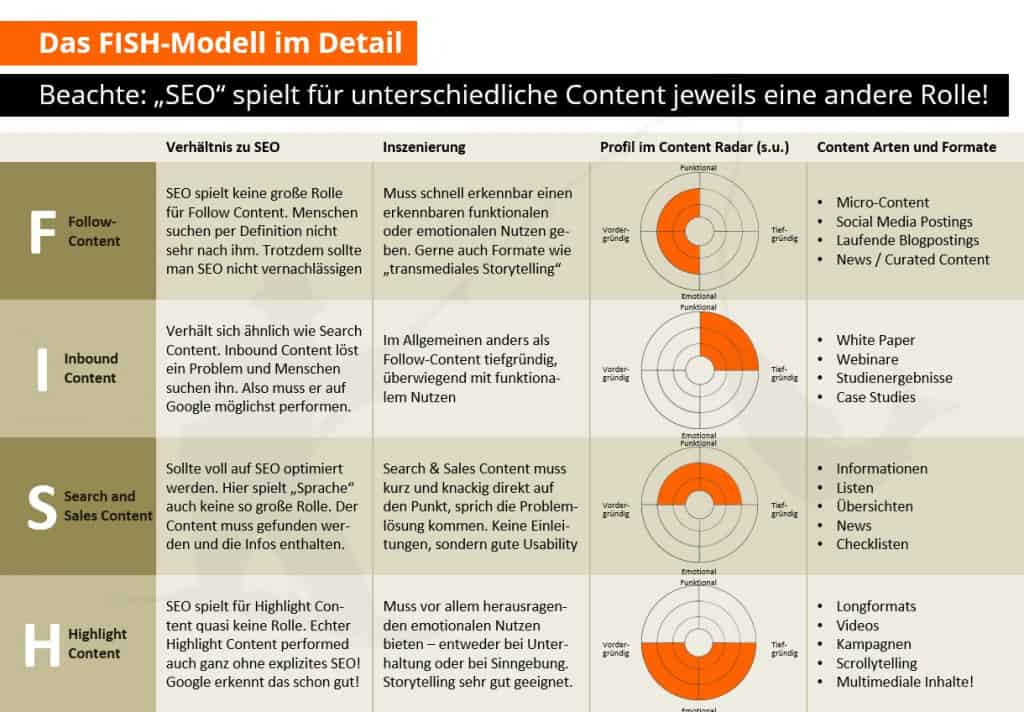
The importance of SEO
And what also becomes clear here is the different meaning of SEO! This was one of the most important findings for me during development, i.e. in relation to the many discussions about the importance of SEO! My conclusion: SEO is still ENORMOUSLY important for inbound and search content, quasi mission-critical. For follow and highlight content, however, SEO plays virtually no role!
My tip:
Assign your content to a content type according to the FISH model and then design it consistently according to the specifications. The categories also result in different requirements for the content: search content is generally the simplest, follow content must be at least above average and highlight content must always be exceptional. And make sure you have a balanced mix: always focus on follow and search content, supplemented by the targeted use of highlight and, if necessary, inbound content.
And combine content types within your subject areas! This is time-consuming but much more efficient because you don't have to make any compromises. This is because the content types are sometimes contradictory: follow and highlight content should be in storytelling format, for example, whereas search content must get to the point immediately (!). And search content should tend to be short and concise, whereas inbound content needs to be more complete.
The Content RADAR
The Content Radar makes a distinction between emotional or functional content on the one hand, and superficial or in-depth content on the other. Both distinctions are very important because content works differently in each area. "Emotional/functional" focuses on the benefit that we convey to the reader. Above all, do they "learn" something? Do they take something away from the text that they can use later? Will they be better informed? Or do we primarily want to convey an emotion that may not have any functional value, but is often even perceived as more valuable?
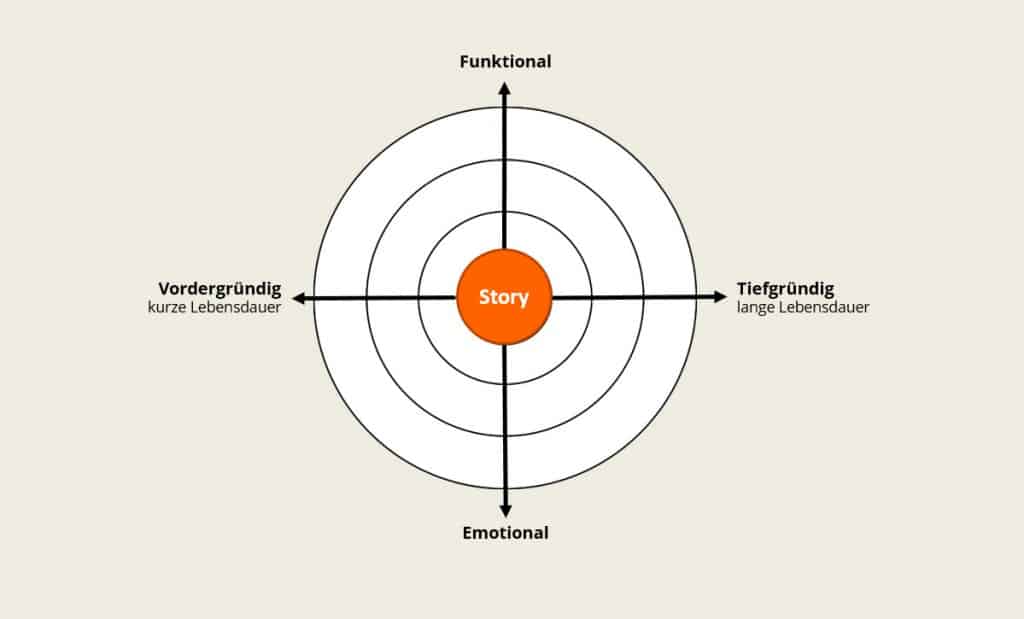
And "superficial/profound" refers to the question of how much time the reader should take. This primarily depends on how interested they are. If there is little or only superficial interest, the content must be short and snappy. Otherwise the reader will lose interest. However, if the reader is interested and is willing to invest time, then superficial content will not satisfy them. Here we have to deliver something profound, and it even has to be long. The reader will always want more.
In this way, from the reader's perspective, four areas of benefit emerge for which different requirements and rules apply:
- News/Information ("I know")
- Knowledge/enabling ("I have learned something")
- Entertainment/fun ("I enjoy it")
- Relationship/meaning ("I have understood it")
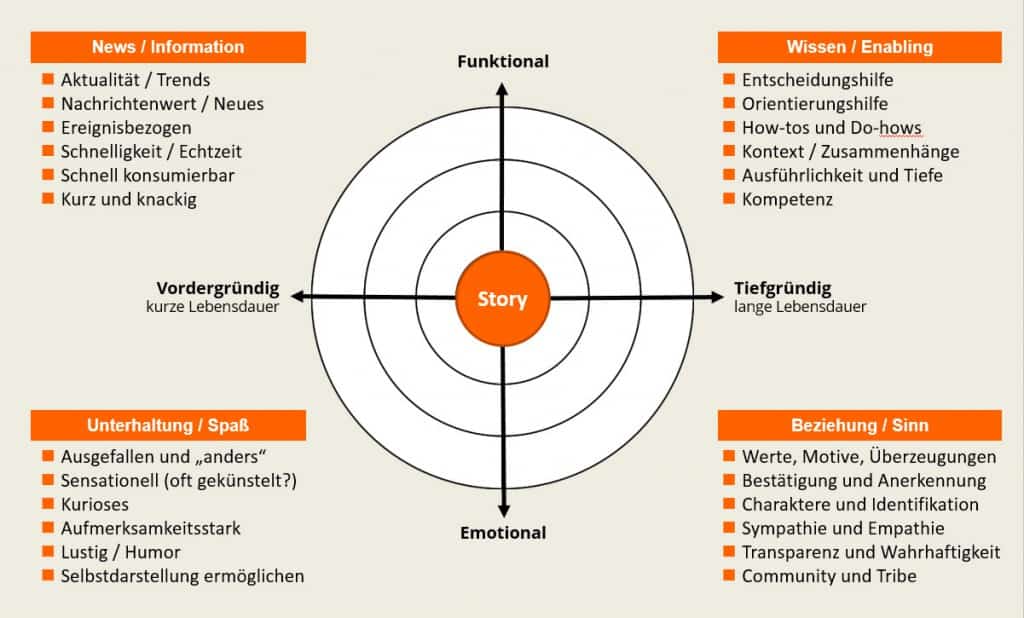
The "News/Information" section focuses on current events and trends. The news value is important here, with speed, timeliness, and exclusivity being particularly important. The "Knowledge/Enabling" section primarily provides guidance and decision-making support, with the depth of information playing an important role here. This section is particularly suitable if you are striving for leadership in a specific area. The "Relationship/Meaning" section is primarily about conveying meaning, clarifying motives, and understanding motivations. And the " Entertainment/Fun" section is self-explanatory.
I recommend setting a strategic focus on one of these areas. We determine for our customers whether we just want to be "me too", "above average" or "leading" in each of the four areas. And this then defines the demands we have to place on production. This also has the aim of focusing resources in order to be "competitive" in one area of activity. Because that's what we are with our content: in competition. We have to be perceived as "better" by Google and then also by the user: the quality of the overall content available determines the standard of the content of each individual company. And these qualities result in different formats for each purpose, but also clear strategic recommendations for individual formats:
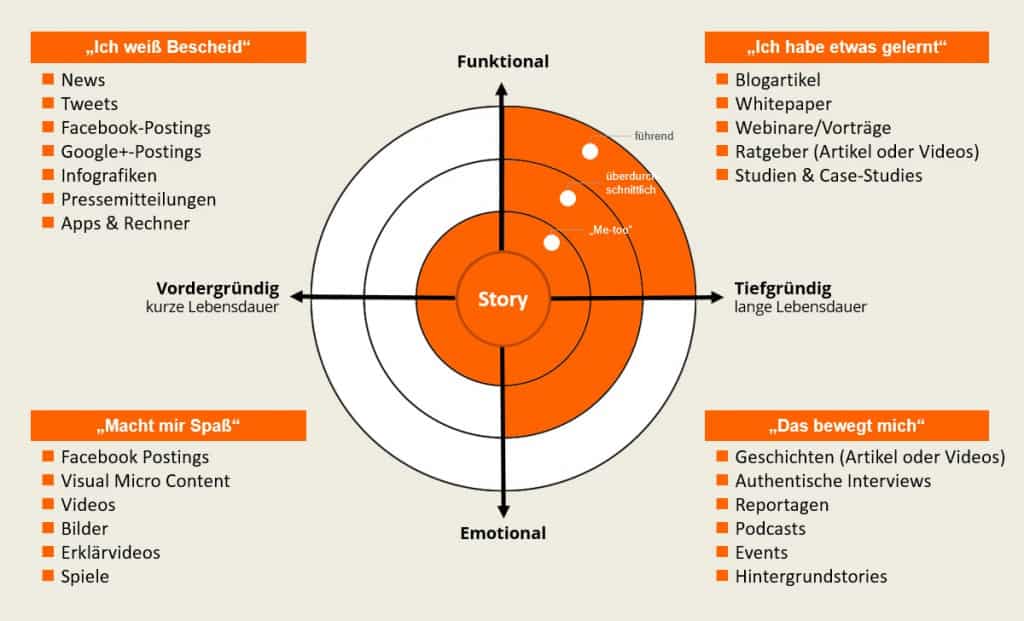
The magazine Curved, for example, focuses primarily on news/information and knowledge/enabling. Here you will find the latest news topics , tablets, and gadgets, as well as in-depth tests and instructions to help you find your way around. Entertainment and relationships, on the other hand, are hardly featured. Red Bull's Red Bulletin, on the other hand, is a great example of entertainment. The magazine is primarily about fun, enriched with some news and stories about people. And the content of "Always" ("Like a girl") or "Dove" ("Beauty Sketches") focuses primarily on "relationships"; they convey a deeper meaning ("significance") by, for example, advocating for girls or "normally built women."
The tip:
Assign your topic ideas to a field of application and try to be at least "above average" in at least one of the fields of application. Then topic a "format" for your topic accordingly, such as a post, an article, or a video. For example, if you want to position yourself as a leader in your field, focus on the "Knowledge/Enabling" area. And if you have addressed the "I" in the FISH model, as in "inbound," the result is a white paper that you market via a landing page. Or you can also set up "follow-up content" and produce a series of how-to videos that allow you to convey your expertise and generate subscribers for your YouTube channel.
And what do you think about that?
I hope that these two tools will also help you in your work. If you have any questions, just write them in the comments below. Otherwise, I welcome any feedback, especially if this post has annoyed you. In that case, I would be very happy to hear why. P.S. Oh, and there is one more software tool: Scompler. We are developing it in parallel with all these methods. It makes "strategic content marketing" work much better.