




Content marketing at HRS: visibility, transparency, transformation

Anyone looking for accommodation while traveling will sooner or later book through HRS. A team at the HRS Group's headquarters in Cologne plays a key role in managing and creating content for communication, using Scompler for this purpose.
Juliane Howitz, Team Lead Content Marketing at HRS, discusses HRS's first steps in content marketing and the resulting central role of her department. She also explains how Scompler has helped to create a deep sense of connection and trust within the team.
Juliane Howitz and her team have to meet complex requirements aimed at communicating with business travelers, travel managers and hotel partners. So it's not just about B2C content: the Cologne-based family business, which was founded in 1972, now generates most of its turnover in international B2B travel management.
However, HRS also continues to generate a significant proportion of its revenue in the B2C segment. This generates an impressive volume of content: HRS created 3,830 pieces of content for this segment alone in 2018.
The focus on content marketing leads to a transformation: #ByeByeExcel'
The current way of communicating is based on a realignment of communication in July 2015 towards a central content marketing approach. At that time, the channel teams were dissolved with the aim of placing content at the center of planning and only then thinking about the playout channels. Juliane Howitz helped shape this restructuring from the very beginning. It quickly became clear that such a change in communication could not be accompanied by a tool like Excel.
Since January 1, 2016, Scompler has been used as an editorial platform that supports strategic communication planning across subject areas, topics, stories, and individual articles. At that time, a transformation began that continues to this day and has not always been easy. "The changeover led to growing pains within the team. This was because all of the colleagues came from individual channel teams that had not actually applied to do content marketing. There were meetings where there was resistance to the changes, and not all colleagues were enthusiastic. Interestingly, many of these colleagues are still here today, and now everyone is happy and finds it totally sensible that we no longer work in a channel-specific manner."
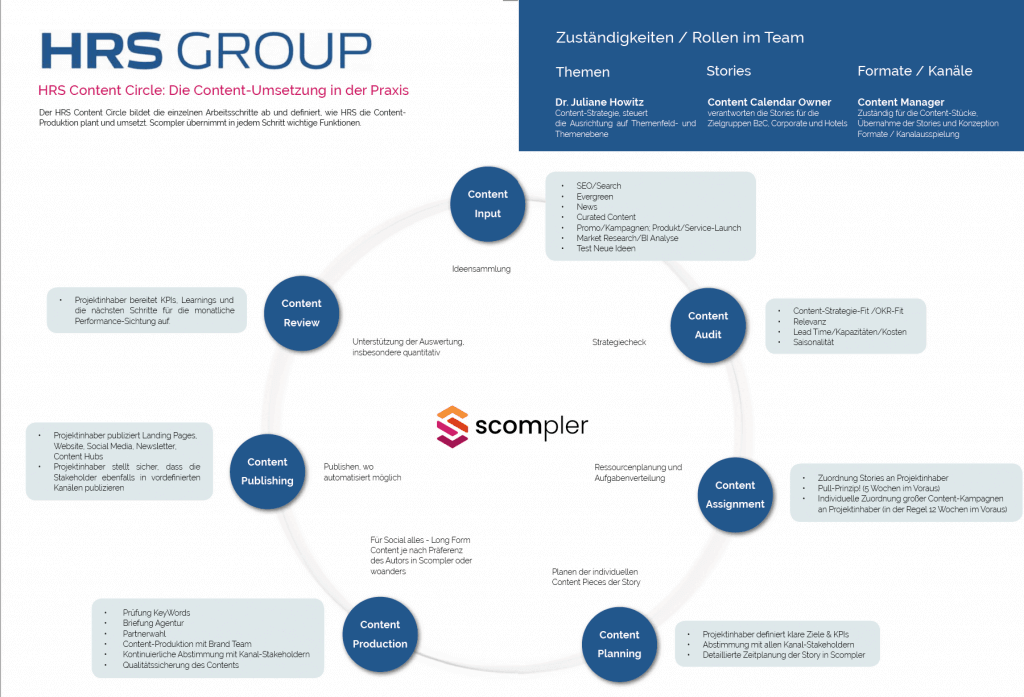
Responsibilities are divided into roles that are also reflected in Scompler. Juliane Howitz is responsible for content strategy and manages the focus on topics and subject areas. Content calendar owners (in the role of editorial managers) are responsible for stories for the three target groups: B2C (business travelers), B2B (corporate customers), and hotels. The content managers are responsible for the individual pieces of content – they take on the stories and consider how these campaigns can be played out in concrete terms on the channels in the various formats.
Changed mindset: Courage to fill the content gap
The mindset of how content is played out and what objectives the content must fulfill has also changed. Topic-centered content planning helped to uncover publication gaps in the calendar - which, however, triggered the impulse in some teams to fill these gaps with content of some kind. In the meantime, very stringent questions are being asked as to whether the content also contributes to strategic goals.
The fact that Juliane Howitz now leads part of the content marketing team is a result of her affinity for strategy and her understanding of collaboration. As a content manager, she was still "involved" in the content strategy alongside her operational activities until she realized that you can't just develop the strategy on the side and that a separate position is needed for this.
"I was probably one of the first in our company to understand that channel marketing is not the future. It's absurd to optimize ourselves to death on a channel basis until we start talking to each other and really working together. So the direction has changed and there is no alternative: we have to create content across channels with the story as the central element."
HRS: Content in figures
An overarching common understanding within the team is one of the most important factors for successful corporate communication. One of the main tasks today is therefore still the mediation function: Juliane Howitz breaks down the strategic aspects and explains to the team the significance for operational implementation.
Juliane Howitz: "After a strategy meeting, people need to know what the strategy guidelines mean for their work in concrete terms. This translation of strategy into operational terms can be illustrated very nicely with a tool like Scompler – and in my view, that's the key to whether content marketing works or not, and also to overcoming existing resistance."
Since the three marketing teams and their responsibilities for the B2C, B2B and hotel partner business units were merged into one team, the content marketing team has taken on a central role in corporate communications. The decisive factor for this was the expertise of the content marketing team, which it had already acquired from its cross-channel work: keeping the quality of communication very high and playing out information consistently across all channels.
Bringing business goals and customer needs together and developing communication strategies based on this approach is a recipe for success. There is no alternative to sitting down together and looking to the future across all channels.
Dr. Juliane Howitz, Team Lead Content Marketing
Today, 70% of all content at HRS comes from the Content Marketing team. Through its intensive involvement with strategically oriented content marketing and the special requirements of this discipline, the team has been recognized internally as a pioneer for new ways of working.
"As a content marketing team, we increasingly became consultants in-house because we acquired special expertise through our cross-channel work. We were often included in meetings by other departments because our working methods were so interesting for other departments. We were often the first to test new developments such as agile working in our team - which is why we are also known internally as the "speedboat"."
Scompler makes production visible: "I happened to see that..."
How the content marketing team was able to establish this central position also becomes clear when you look at the acceptance of Scompler within the company. In the first year after its introduction, other departments were rather hesitant when it came to working with Scompler. They usually only wanted read access at first, or as Juliane Howitz explains: "We want to see how it goes." After that, there were frequent surprised comments from her colleagues, who repeatedly pointed out productions from other departments that they had discovered in Scompler and could use for their own work.
Scompler created a new visibility, a transparency that led to comments such as "I happened to see that..." or "Oh, we wouldn't have noticed that otherwise." Juliane Howitz sees this as the "starting point that led to us now having a joint editorial meeting." All departments now participate in this weekly editorial meeting: internal communications, PR, performance marketing, the content marketing team, and other units. "And then we open the calendar and the stories in Scompler and discuss the approach for the next six weeks."
Transparency has triggered a lot. There has to be friction in order to build trust afterwards."
"Transparency has triggered a lot. There was the realization that you gain added value through transparency about what you are working on and the work processes become visible." This visibility can also be uncomfortable and reveal differences. For example, it became clear that one team was very well organized and worked in two-week sprints, while another team did everything inefficiently on demand.
Juliane Howitz considers the resulting friction to be necessary in order to establish trust, which also results from working with Scompler. Juliane Howitz comments: "We simply trust each other. Because my colleague has posted a content production in Scompler, I don't have to worry. I know that my colleague will have it finished by a defined deadline, otherwise he would enter it differently. Scompler creates trust: everyone does their job, always with the best of intentions. This trust in each other's expertise has come about because we have practiced transparency. Namely through Scompler and this 'I happened to see that...'."
Because everyone in the marketing organization has read access to Scompler, communication is consistent and planning and production are binding in terms of content and timing. "Transparency is the maxim. The platform allows us to reflect what is important to us at an operational level. Scompler has accompanied us as a tool since our first steps in content marketing – I therefore cannot imagine that the transformation we have undergone to date would have worked without Scompler. Transparency has led to trust. And trust has led to a different feeling of connectedness within the team."
on the road. The digital travel magazine from HRS
Planning, workflow, promotion, publication
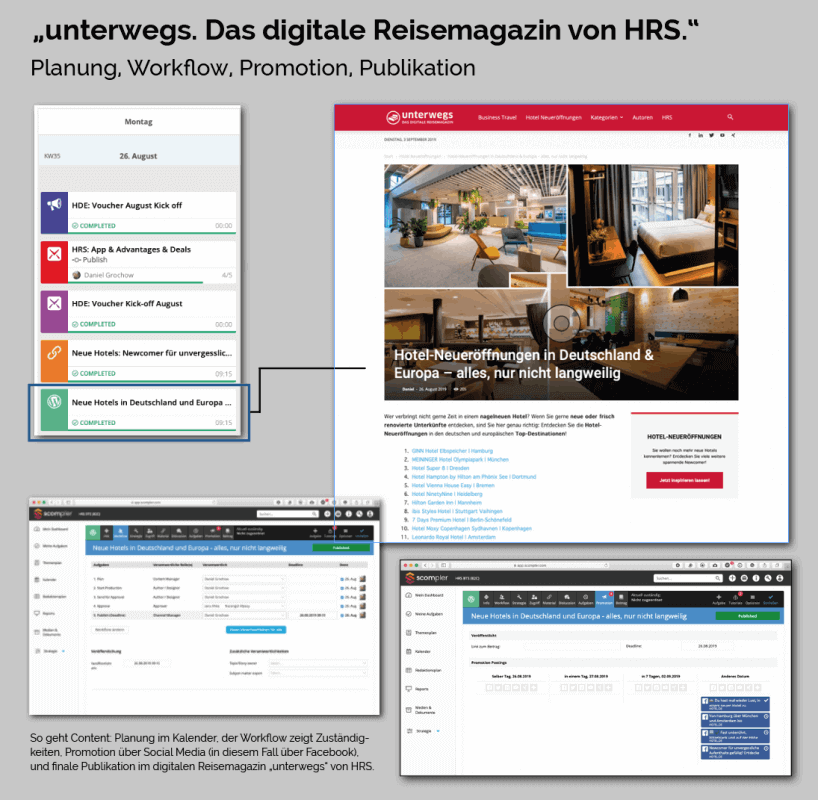
HRS Content Circle: Content implementation in practice
Work steps: Content planning and implementation
Return on investment: What working with Scompler has brought us
"An important question for us was how much working time a tool would save us. It was a simple comparison of resources and production times.
In terms of resources alone, we have saved around 20% of time in the overall process, from the idea to the publication of a story, since we introduced the content process. The capacities freed up by efficient coordination processes can in turn be used in a targeted manner. In terms of time-to-market, this also means that we work at a different speed, can react quickly and implement our communication faster.
It is a recipe for success to bring business goals and customer needs together and develop communication from this. There is no alternative to sitting down together and looking to the future across channels - because we don't know what channels will be available in five years' time, because it is simply more efficient and because the people you want to reach are increasingly annoyed if you don't do it."
Juliane Howitz, HRS