










Content planning for videos
Content planning for videos: Five steps to effective corporate videos
Videos are among the most attention-grabbing formats in corporate communication and marketing communication. No other medium combines emotion, information and activation so directly. And yet many corporate videos fall short of their potential - because they are not embedded in an overarching strategy.
Content planning for videos: how to make videos your strongest asset
To ensure that videos are not simply measured by impressions and clicks, but that the meaning and purpose behind them is also visible, they must be managed in a targeted manner - as part of strategic communication planning. Embedded in a company's communication and topic strategy, high-quality and emotionally charged videos can be a real asset - possibly more powerful than any other.
1. Position topics with videos in the long term - not just selectively
Instead of producing videos on an ad hoc basis, it is important to develop topics strategically topics longer periods of time. Companies should ask themselves: What do we want to stand for? What messages do we want to continuously reinforce? And how can the video format help us convey our messaging to our target groups?
A video alone is not enough – but as part of a clearly defined topic architecture, it can be an effective amplifier. This creates consistency in content, better strategic control, and also integrates a prioritization of which video topics we focus on within the company.
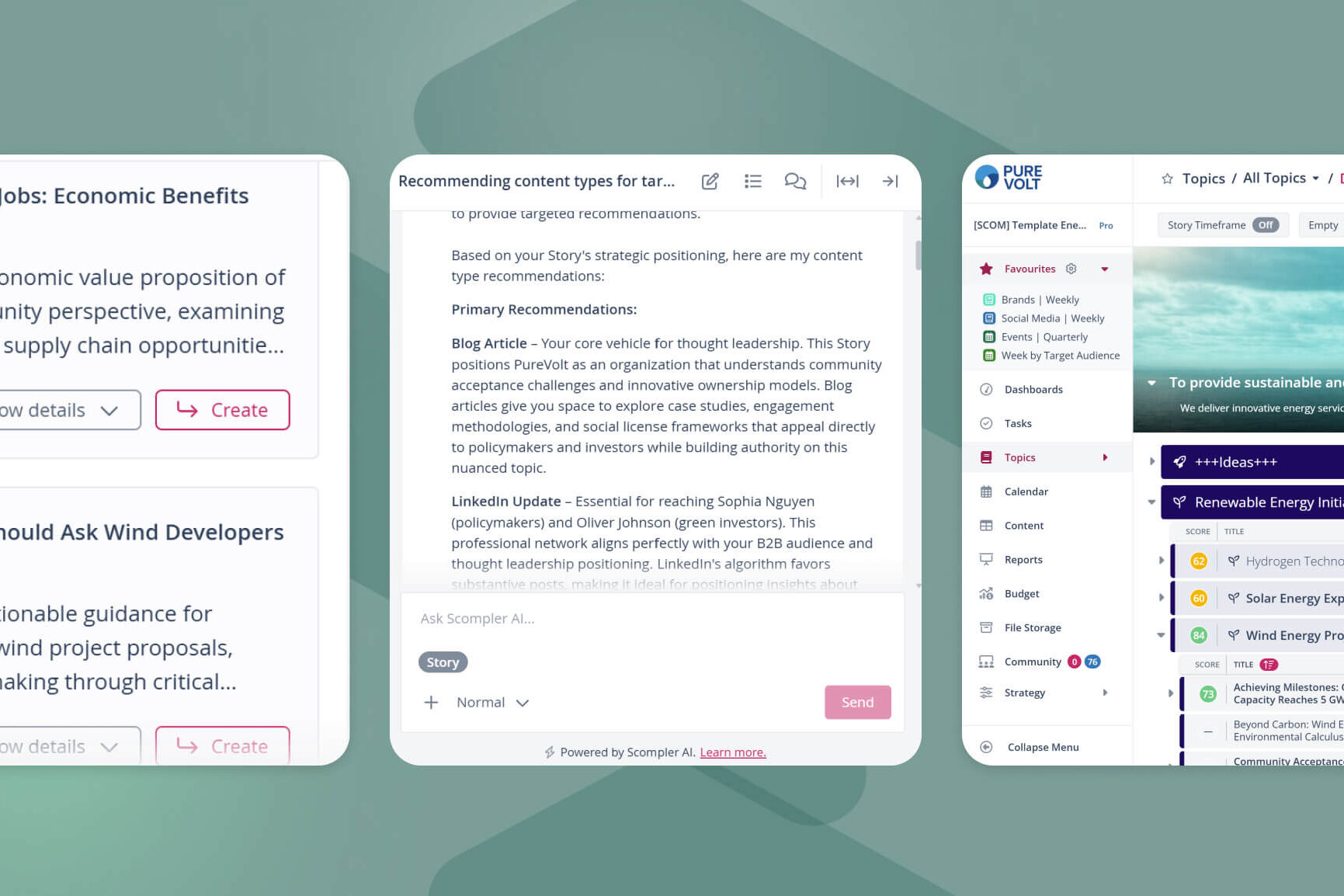
In Scompler, teams plan their video content based on strategic goals and topics with other content types.

2. Plan videos based on topics —not channel or format driven
Many video projects start with the question: "We need more videos for Instagram – what can we do?" But that's the wrong approach. Instead, the question should be: "What topic do we want to cover, for which target group, and what format is best suited for it?"
A video is an integral part of a comprehensive content strategy. This means that a video tells a story embedded in a topic, complements other formats (e.g., press releases, blog posts, infographics, podcasts, or intranet posts), and is planned and played out along campaigns, special topics, or editorial plans. This creates consistent storytelling across channels and formats—and video goes from being "silo content" to a strategically managed amplifier.
3. Define strategic goals and KPIs
A video without a goal is just a more or less successful contribution. To be effective, it needs clear objectives:
- In which phase of the customer journey is it most effective?
- What is it supposed to achieve?
- Who should it appeal to?
Whether brand awareness, activation or knowledge transfer - every objective needs its own suitable KPIs: Watch time, engagement rate, conversions, qualitative feedback, thought leader engagement. This is the only way to systematically measure and optimize the impact of your videos.
This video is provided by YouTube. To watch it, please adjust your cookie settings.
4. Plan and produce videos in an integrated setting with clear responsibilities
A strategy can only become visible in everyday life if its implementation is structured. That's why video projects must be planned in an integrated manner —with clearly defined responsibilities, deadlines, and approval processes. Scompler, as a central platform for content planning, enables exactly that:
- Responsibilities, briefings, deadlines and approvals are transparent and traceable
- Status, milestones and publication dates are visible in the editorial calendar
- Videos are planned on an equal footing with other formats such as website texts, press releases or social media posts
- By structuring content according to topics, channels, and target types, content recycling becomes predictable—and video content can serve as the basis for follow-up formats.
5. Regularly reflect on performance and impact
Once a video has been published, it is not a finished project—rather, it should be the start of impact measurement and KPI analysis, with the results being used to continuously optimize content planning. What worked well and what didn't? How was the video perceived—including in the context of overall communication on a topic?
The impact of a video should not be analyzed in isolation, but in the context of the overall topic strategy:
- Did it contribute to achieving the goal?
- What lessons can be topic for future videos or other formats on this topic ?
- How can the video be reused or expanded with other content?
Conclusion: Content planning for videos must be managed holistically
Videos only develop their full effect if they are strategically planned, thematically embedded and systematically controlled. They are not isolated individual measures, but valuable components of an overarching communication and content strategy. If you think about video content in a goal-oriented way, plan with clear responsibilities and focus, you will not only gain in efficiency - but also in relevance and impact.