







Whitepaper, presentation and webinar recording
7 cardinal mistakes in the corporate newsroom
Hardly any other development has had such a strong impact on communication and content marketing in recent years as the corporate newsroom. However, false expectations and misconceptions about the corporate newsroom often lead to it not functioning properly in corporate communications. Scompler founder Mirko Lange and the inventor of the newsroom model, Prof. Dr. Christoph Moss, have identified a total of seven cardinal errors in their daily consulting practice that contribute to the corporate newsroom not functioning properly.
In a joint webinar and at the 2023 Communications Congress, they presented these mistakes and provided communicators with valuable recommendations for action. You can download the white paper on the seven cardinal mistakes here!

Mirko Lange
Mirko Lange is the founder of Scompler and a consultant and lecturer on content strategy and content marketing. Scompler is used in more than 300 newsroom projects.

Prof. Dr. Christoph Moss
Prof. Dr. Christoph Moss is Professor of Communication and Marketing. He developed the corporate newsroom model and has advised and implemented it in more than 120 newsrooms with his agency Mediamoss.
Cardinal error
01
"We don't need structures. We are agile."
A newsroom is agile by its very nature. However, if you do away with structures in it, you lack the basis for managing the people who have to implement corporate communications. The implementation of clear newsroom structures often fails because topics media are not managed separately from each other. Another typical mistake is to do without a managing editor and their coordinating function: "It's a big bus and it needs to be steered," says Moss.
02
"We are too small for a strategy!"
"Small companies generally have very limited resources, which they therefore have to use all the more wisely in order to be successful," emphasizes Mirko Lange. Small corporate communications departments in particular should therefore keep their own company's goals clearly in mind and derive strategy-appropriate communication goals and measures from them in order to be able to contribute to the company's value creation as effectively and resource-efficiently as possible. A strategy is of central importance for a functioning newsroom, as it provides the guidelines for decisions in the day-to-day running of the newsroom.
03
"We don't plan. We are too dynamic for that."
"Life is what's happening while your making plans". Many newsrooms operate according to this motto. Companies think that they have to react to events as they happen. But this is a mistake. The vast majority of communication can be planned - or prepared - in advance. This not only increases the quality of work but also the quality of life of the experts in the newsroom. Topic planning does not mean being rigid, but rather giving communicators the flexibility they want: "If you know you already have everything in the drawer - metaphorically speaking - then you can be wonderfully flexible and respond to what happens," says Moss.
04
"The specialist departmentstopics for us."
Most communications departments see themselves solely as service providers for the specialist departments. Whatever they specify and want is implemented. However, communicators need to take more of a leadership role. An optimal newsroom organizes itself around key topics and communicates strategically. Topic managers derive these key topics strategically from the company's goals and obtain appropriate topics the specialist departments themselves. The resulting topic architecture guides the implementation of communication events in everyday work.
05
"Google tells us what good topics "
The two experts recommend a more strategic approach in the form of topics: "When specialist departments topics with their individual topics , it is important to let the gatekeeper have their say and say 'this topic not topic any points in a topics and does not contribute to our goals, so we will not pursue it'." Such scoring enables clear prioritization. This is essential in the newsroom to ensure that only content on topics that contribute to the predefined communication goals is topics and to guarantee the quality of the content.
06
"We use Excel for project management"
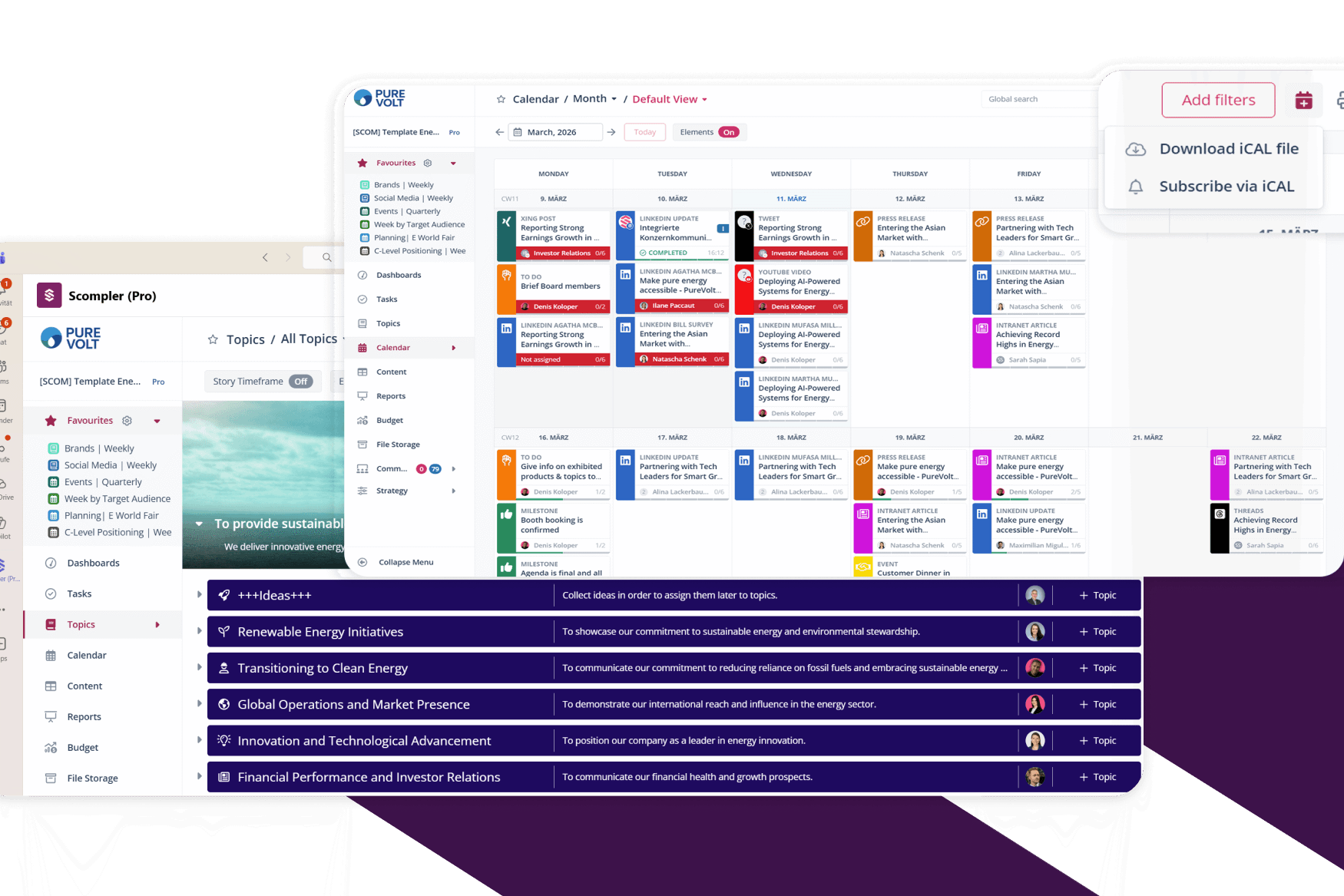
Mirko Lange began developing a strategic editorial plan for Deutsche Bahn in 2012, concluding: "It was the most ingenious editorial plan imaginable. It had only one flaw: it was completely unusable. It was so complex that it was impossible to implement in day-to-day business." What is needed is a holistic content planning tool that breaks down silos and creates full internal transparency about what is communicated and when. The project with Deutsche Bahn was the catalyst for the development of Scompler. Today, more than 300 companies use the tool, including seven DAX-listed companies.
07
"We control with data that is readily available"
The most important goal of corporate communicators should be to bring key topics to market as effectively as possible, rather than generating reach. topics That's why it's not enough to just measure reach and channels. We have to topics topics the impact of topics Moss emphasizes. The data must be traceable back to the stories, the topics ultimately the company's mission in order to draw clear conclusions about the performance of the content across all channels.
This video is provided by YouTube. To watch it, please adjust your cookie settings.