









Communication as a System
Why content isn't the problem—it's context
In many communications departments today, day-to-day work is less driven by strategic considerations than by the expectation to produce ever-increasing amounts of output.
The demands placed on corporate communications have changed fundamentally: Today, content must not only be produced, but also strategically managed, orchestrated across channels, and continuously refined.
The editorial calendar is packed: more and more new channels need to be updated, campaigns are running simultaneously—and at the same time, new content is constantly being generated by AI.
Communication as a system? Many organizations lack unifying topics goals
At first glance, this seems like a sign of effective communication. Companies are present, visible, and reach their target audiences through a variety of touchpoints. Reach can be measured, formats scaled, and processes optimized.
However, as Maximilian Miguletz points out, organizations today produce more content than ever before. At the same time, many organizations lack a clear link between strategic goals, topics concrete actions—leaving communication fragmented.
The real problem isn't content—it's context
Different teams create content in parallel, interpret topics , often fail to clearly define narratives, and let channels follow their own logic. As a result, while communication takes place continuously, it rarely comes across as a coherent whole. Typical symptoms keep cropping up:
- Content appears interchangeable or redundant
- Messages contradict each other across channels
- topics quickly topics visibility
- Individual measures have no lasting impact
“Communication isn’t a task. It’s a system—and when that system is fragmented, the results are inevitably fragmented.”
Maximilian Miguletz, Director of Strategic Communications at Scompler

The Paradox of Modern Communication
It has never been easier to produce content. Digital platforms, content management systems, and, increasingly, artificial intelligence make it possible to create content faster and more efficiently than ever before.
However, this increases the risk of losing sight of the strategic context. Communication takes on a life of its own: what is produced quickly is published quickly. This creates a cycle in which output becomes an end in itself. More content does not lead to greater clarity, but often to greater fragmentation.
When publishing is confused with communication
“Are we actually communicating—or are we just publishing?” Publishing produces output. Communication creates meaning, clarity, and trust. Or to put it another way: Publishing answers the operational question , “What are we sending out? ” Strategic communication answers , “What do we stand for?”
When organizations structure their communications efforts primarily around content production, the focus inevitably shifts. Efficiency increases, as does the pace—but the strategic direction becomes increasingly difficult to discern amid all the content. This is precisely where impact is lost.

Why operational improvements aren't enough
When communication fails to achieve its intended effect, the cause is often assumed to lie in operational matters: new tools, optimized processes, or larger teams are supposed to solve the problem
However, Miguletz makes it clear that this is neither a problem with tools, skills, nor motivation—but rather a structural gap.
In most organizations, this structure has evolved over time. New channels, formats, and requirements have been added over the years without fundamentally rethinking the underlying logic. Strategies exist in presentations, narratives in documents, and content in various tools. But what’s missing is the connection.
Communication as a System – Integrated and Strategic
This is precisely where a different perspective on communication comes into play. Communication is not a collection of individual measures. It functions like an integrated management system—comprising strategy, topics, narratives, content, channels, and target audiences. The key point is not simply that these elements exist. What matters is whether they are structurally interconnected.
Without this connection, gaps inevitably emerge—between strategy and execution, between teams and channels, and between content and impact. Strategic guidelines remain abstract, while day-to-day operations are dominated by short-term demands.
AI exacerbates the challenge
Generative AI is further accelerating this trend: content can be created, adapted, and scaled in no time.
But speed alone does not create a strategic impact. On the contrary: the easier it is to produce content, the more important the question of how to categorize it becomes:
- Which topics truly relevant?
- What narratives should we build?
- Which content actually contributes to strategic goals?
AI can generate content and optimize processes. What it cannot do is place communication within a broader strategic context.
Think about communication topic
One possible solution to this problem lies in a change of perspective. Many organizations structure their communication around channels.
Strategic communication works differently. It doesn’t start with the channel, but with topic. Channels don’t define the direction— topics .
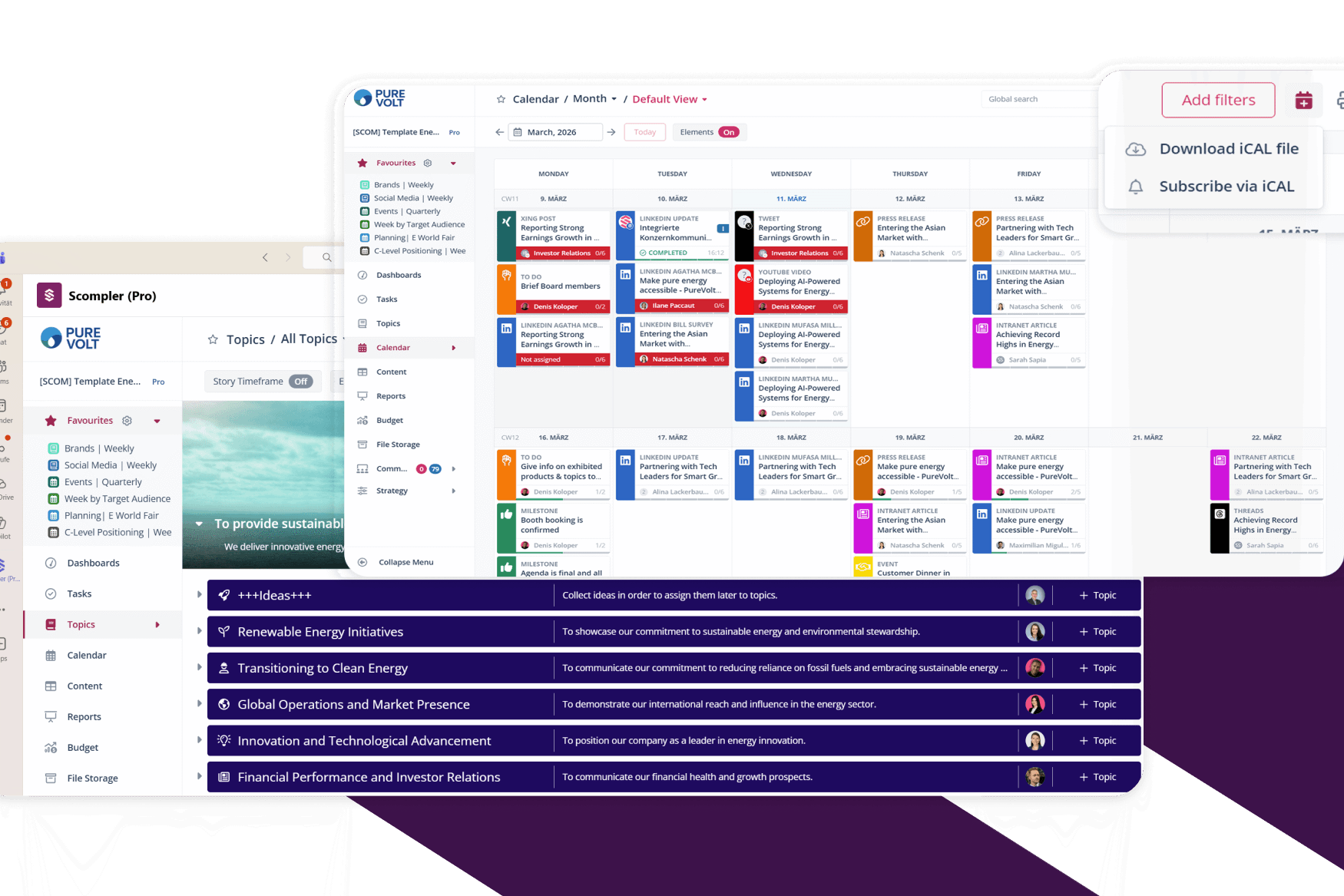
This shift in perspective is central to modern content operations: communication is no longer planned around channels, but rather around a strategic topic architecture.
Read the guide now: From Corporate Strategy to Thematic Architecture
The theme-centered approach
Conclusion: Impact comes from the system
More content or additional tools will not solve the challenges of modern communication. What is crucial is a shift in perspective: communication must be conceived of and managed as an integrated system.
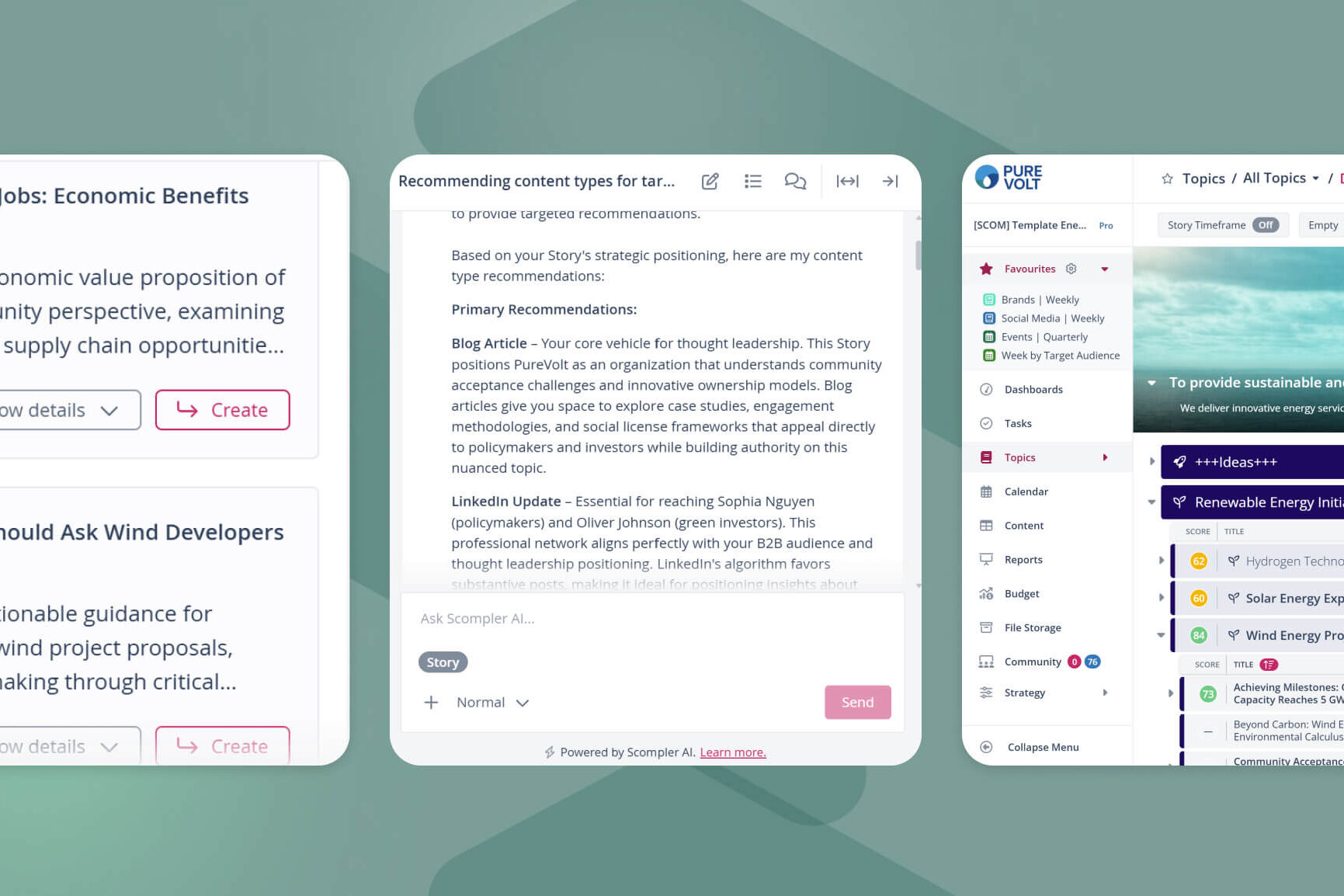
A Strategic Communications OS lays the groundwork for this—it bridges the gap between strategy and execution, reduces complexity, and enables real impact.
With Scompler, this approach becomes operationally feasible: communication becomes manageable, scalable, and strategically effective.