






The 8 levers of strategic content marketing
One achievement of content marketing is that companies are starting to think more empathetically, i.e., more from the customer's perspective. But that's just the beginning. We need personas, no question about it. We have to think about their customer journey; that's a must. But even that's not enough. Above all, we need a holistic view of all possible touch points. This article aims to highlight the areas where our reference groups come into contact with content that affects us. To communicate effectively, we as communicators must gain influence in all areas. And one thing is particularly clear: how necessary it is for areas that are often organized in silos to work together. Good, modern companies are already doing this. This article aims to show how close this should (or could) be.
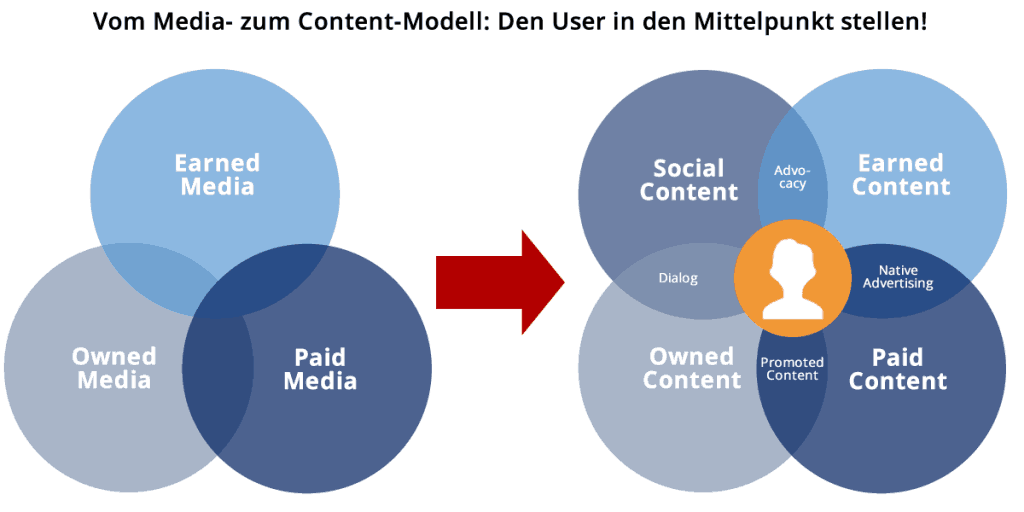
Anyone who starts to deal with "content" or "social media" will sooner or later come across "the chart with three circles", which shows three types of media: Owned Media , Earned Media and Paid Media.
This actually refers to "media", i.e. means of communication, and specifically the model means the channels, or even more precisely, whether and how I as a communicator can use the channels. I have complete control over my own channels ("owned media") and can post and write what I like there, e.g. on my own website. I can only use paid media if I pay for it, i.e. mainly advertising. And to get into "earned media", i.e. editorial coverage, I have to "earn" it first, usually through PR. In other words: "Owned media" is my own car, "paid media" is the cab and with "earned media" I hitch a ride.
The "media model" is outdated and inadequate!
But anyone who delves deeper into the" topic " content strategy will eventually realize how outdated and inadequate this model is. That’s because it makes the same mistake as so many of the (old) marketing theories: it doesn’t look at things from the user’s perspective. And it doesn’t take into account the unique characteristics of the digital world. First, it’s now only indirectly important “where” I speak; what’s far more important is “what” I say. And second, the recipient doesn’t just perceive what “I” say-on the internet, everything blends together into an incredible polyphony, and all too quickly, it can turn into a cacophony.
Then my beautifully crafted messages will either be overshadowed or counteracted. So anyone who thinks strategically, i.e., in a goal-oriented way, would do well to consider what the "recipient's horizon" is. And they should ask themselves: How can we as communicators control what "content" the target group receives? How do we manage "polyphony" (many voices), prevent "cacophony" (bad voices), and perhaps even create "symphony" (with a common voice)?
Only in the triad of message, acceptance and reach does content marketing generate value
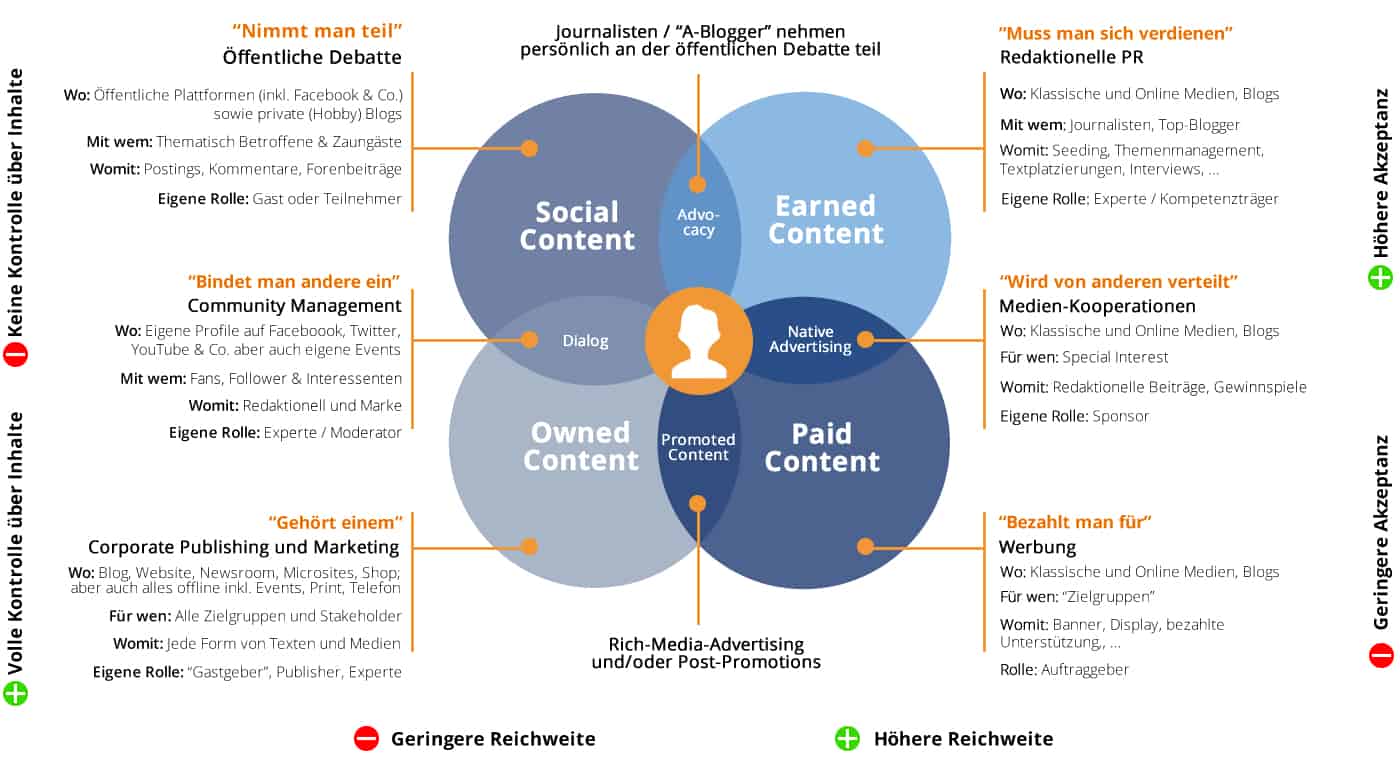
And here is the central graphic:
The dimensions of content control
"Content control" is a nasty word, isn't it? Do you always have to "control" everything? Spontaneously, you will have to say anyway: We have no control! And depending on your taste, you can also add a "more". The "loss of control" in the age of social media is almost proverbial. First of all, a closer look reveals that "content" has three dimensions: The understanding of the content, the reach and the acceptance.
We have to say goodbye to a concept of control that has dominion over every detail. There is no such control and never has been. But we can understand "control" as controlling the overall impression. Like a current account. Our task is to keep our reputation account in the black. And even if there are "uncontrolled withdrawals", we can still balance the account. And that is exactly what modern communication management is all about: knowing where withdrawals are being made, whether they are relevant and, if so, replenishing the account in a targeted manner.
A systematic understanding of content: Eight levers of influence
The four basic types of content
And in a slightly different model of the "media model", we can represent all three dimensions well. The terms are similar, but they do not refer to the "medium", but to the "content". From the recipient's point of view, the channel is irrelevant; they are only interested in the content that they receive via these channels. And nowadays, the types of content are mixed up in the channels; all types of content can be found in every medium: paid content (advertising), editorial content, content created by companies (see advertorials and native advertising) and content from readers in the form of comments. In detail, this results in three basic types of content:
- "Owned content" is content over which I, as a communicator, have complete control. I can control 100% of what I say. If I want to, I can move every single pixel to where I want it to be. I can think about every single dot. And I can run a text through 20 rounds of proofreading. However, I have little or no control over the reach of this content. And the acceptance and credibility of this content is generally low-at least lower than, for example, editorial content.
- Paid content is content over which I have complete control in terms of reach. At least technically. I can go to my media agency (or Facebook's ad manager) and select exactly who I want to reach and how many of them. I can control this through "targeting" and media use: the more I invest, the more people I reach. At least in theory. I can also control the content in paid content, but only to a very limited extent because space is usually very limited. Space costs money. And just like with owned content, the acceptance and credibility of this content is low.
- "Earned content" is content that I, as a company, have to "earn." It is mainly created by editors and "A-list bloggers." Its reach is usually significantly greater than that of our own media, and its credibility and acceptance are also very high, but we have no control over it. Nevertheless, we can "influence" the content. This is the domain of PR; as a company, we can get to know the editors and bloggers who have a wide reach and/or are particularly credible.
- Social content is content that is created "jointly" by the public. You have to earn this too. However, it is much more heterogeneous than earned content, much more chaotic, and basically completely anarchic. You can perhaps moderate this content, but it eludes any influence or even control.
A systematic understanding of content: Eight levers of influence
The mixed forms of content
What is interesting about this model are the hybrid forms. This is because other types of content are created at the interfaces:
- "Fan dialogue": Interaction occurs at the interface between "owned" and "social." It is important to understand that dialogue also generates content-and that this content is both observed and used by recipients. On the one hand, the public uses dialogue to assess how a company treats its stakeholders. On the other hand, this content contains a wealth of information. Just think of "service communities," where you often don't even have to ask a question yourself, but can read how your question has already been answered for someone else.
- Native advertising: At the intersection of earned and paid media, a (new?) discipline is currently emerging, namely native advertising. This is where editorial content and paid advertising merge. In the past, this was called advertorials. As a company, this allows you to increase both the reach and acceptance of your content, but you lose some control over the content: you can no longer design it for advertising purposes, but must design it editorially.
- Advocacy: And at the intersection of earned and social media, advocacy or ambassadorship emerges. When credible journalists or bloggers with a wide reach participate in public discourse, it greatly enhances the reputation of the content.
- Promoted content: New types of content have emerged at the interface between owned and paid content, such as rich media ads and post promotions. We call them "promoted content." This allows companies to either increase the reach of owned content (e.g., through Google AdWords or Facebook post promotions) or increase the formerly "thin" content of advertisements.
The eight levers of content control
And here they are, the eight levers. The model helps to better orchestrate content in content marketing-specifically, content that (potentially) resonates with users. So anyone who takes "content" and "content marketing" seriously has eight "levers" they can use. And with all levers, they appear with different goals and different roles (see above). If you want to be really good, you use all of these levers in an orchestrated way and orchestrate them as well. But I want to repeat once again: it all comes down to the content! It doesn't matter "whether you're in the channel," for example, whether you have a "clipping" in the "FAZ."
A systematic understanding of content: Eight levers of influence
That's the channel-oriented way of thinking. It depends on what's in the channel. And then it's also important that the other types of content in the channel don't lead to the cacophony described above, and that, for example, all users complain in the comments on faz-online.de and on Facebook (in the comment on the link there) about what nonsense the article is (social content). Or if there is a link in the article to a website where there are suddenly other messages (owned content). It depends on the content! Or more precisely: it depends on what content reaches the user. And they topic different content on topic !
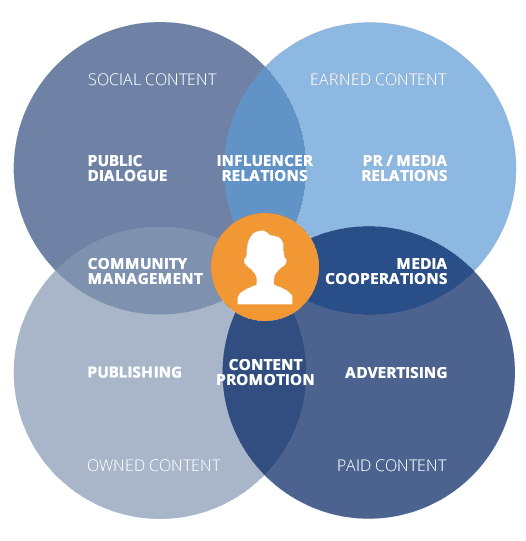
- Publishing: The basis is almost always "owned content." Depending on the strategy, it can be geared more toward the company, thereby strengthening the brand, or designed to be more editorial in order to increase acceptance and reach-through more sharing, a higher Edge Rank, and better placement in search engines.
- Content promotion: This is an interesting hybrid form of advertising that increases the reach of "owned content" or enriches the content of traditional advertisements. Here, you are "advertising content." This is different from traditional advertising, which typically promotes a product directly.
- Advertising: Traditional advertising continues to play an important role in generating reach-especially when you have messages that (only) serve the interests of companies.
- Media Cooperations: The combination of "earned" and "paid" is increasingly becoming a very valid way to distribute content with good reach and high acceptance. "Native advertising," a modern interpretation of "advertorials," is very much in vogue, but joint competitions, quizzes, and prize promotions also work very well.
- PR/Media Relations: Earned content is the classic field of activity for PR and/or blogger or influencer relations. Its reach and acceptance are even greater than those of native advertising, but it requires even more editorial thinking and a greater willingness to put your own interests aside.
- Influencer relations: Advocacy is essentially the highest art of PR and blogger relations: when you succeed in getting journalists or bloggers to write about you not only in a professional capacity, but also because they are personally convinced.
- Public Dialogue: And "dialogue" is ultimately the interface between "social" and "owned." This encompasses both community management and service. This content is extremely valuable because it arises "on its own," so to speak, and is very authentic and therefore accepted.
- Community management: Social content is the least influenceable or controllable type of content. Here, everyone writes what they want. Influence can only be exerted through genuine behavior-both in real life through good products and services, and in public communication, especially through good community management.
The model makes it clear how interwoven all disciplines are. From the consumer's perspective (in the middle of the graphic), everything blends into a great polyphony - either as a synphony or a cacophony. Companies that manage all eight disciplines well will be at the forefront of the new media world. And the more silos are broken down in companies, the better.