






AI as a Strategy Partner
One Voice, Relevance, and AI Visibility in Communication and Marketing
In most communications and marketing teams, there is a gap between “AI is being used” and “AI contributes to success”-a gap that can only be bridged if AI is embedded in strategy, topics , and goals.
Three Pillars: One Voice, Relevance, and AI Visibility
That’s why we’re not interested in how much faster AI can produce content, but rather in what AI can truly achieve in strategic communication once it moves beyond mere content production. These three pillars are at the heart of this.
- One Voice – a consistent brand voice across all channels. AI without guidelines makes content seem generic; well-integrated AI maintains the brand’s unique voice.
- Relevance -content that contributes to goals and target audiences, rather than output for output’s sake. In the age of AI, the bottleneck is no longer the production of content, but the decision of what to communicate in the first place.
- AI Visibility – Becoming visible and citable in the responses from ChatGPT, Gemini, and Claude. This isn’t achieved (solely) through tricks, but through thematic relevance and consistent messaging over time.
In this whitepaper, we share insights and best practices-including those from communications professionals at Boehringer Ingelheim, E.ON, Heineken, and Giesecke+Devrient-as well as reports and case studies from leading agencies.
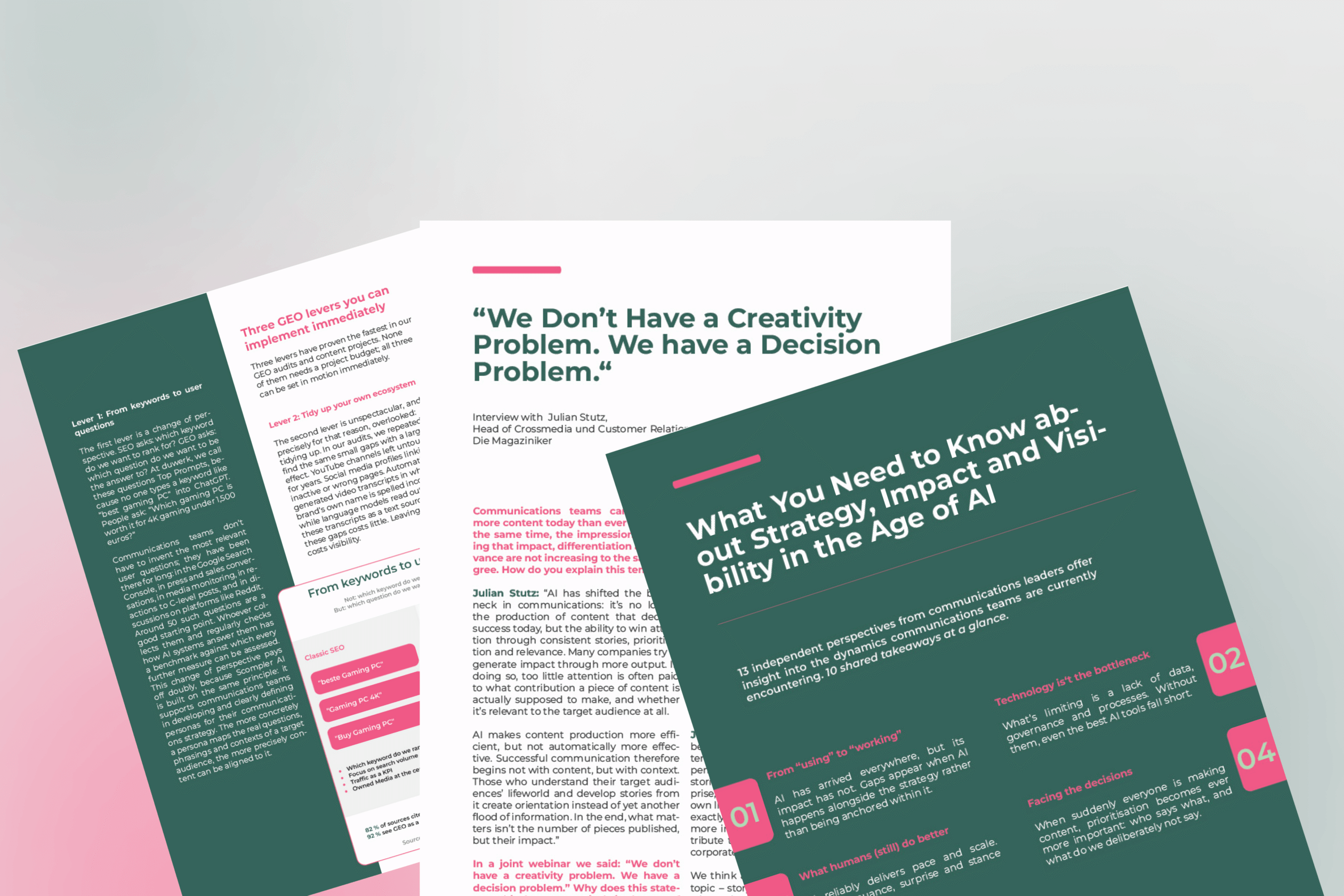
Get the complete guide-featuring all the expert interviews, guest articles, topic architecture insights, and the GEO Quick Check-for free as a PDF.
What can AI accomplish as a strategic partner in communications?
According to the whitepaper, AI provides added value to communications experts primarily in routine, operational tasks: research, summaries, translations, first drafts, and the analysis of large amounts of data. What it does not replace-and communicators at E.ON, Heineken, and Boehringer Ingelheim agree on this-is strategic judgment: the selection of topics, their prioritization, and the perspective behind a story remain (for now) a human endeavor.
The real bottleneck, therefore, is not the technology itself, but the foundation on which it is built. Without clear goals, narratives, topics , and responsibilities, AI may boost output but not the impact of communication. It is precisely this grounding that distinguishes a simple AI writing assistant from technology that serves as a strategic partner.
AI as a Strategy Partner: 13 Perspectives from Communications Professionals in Our Whitepaper
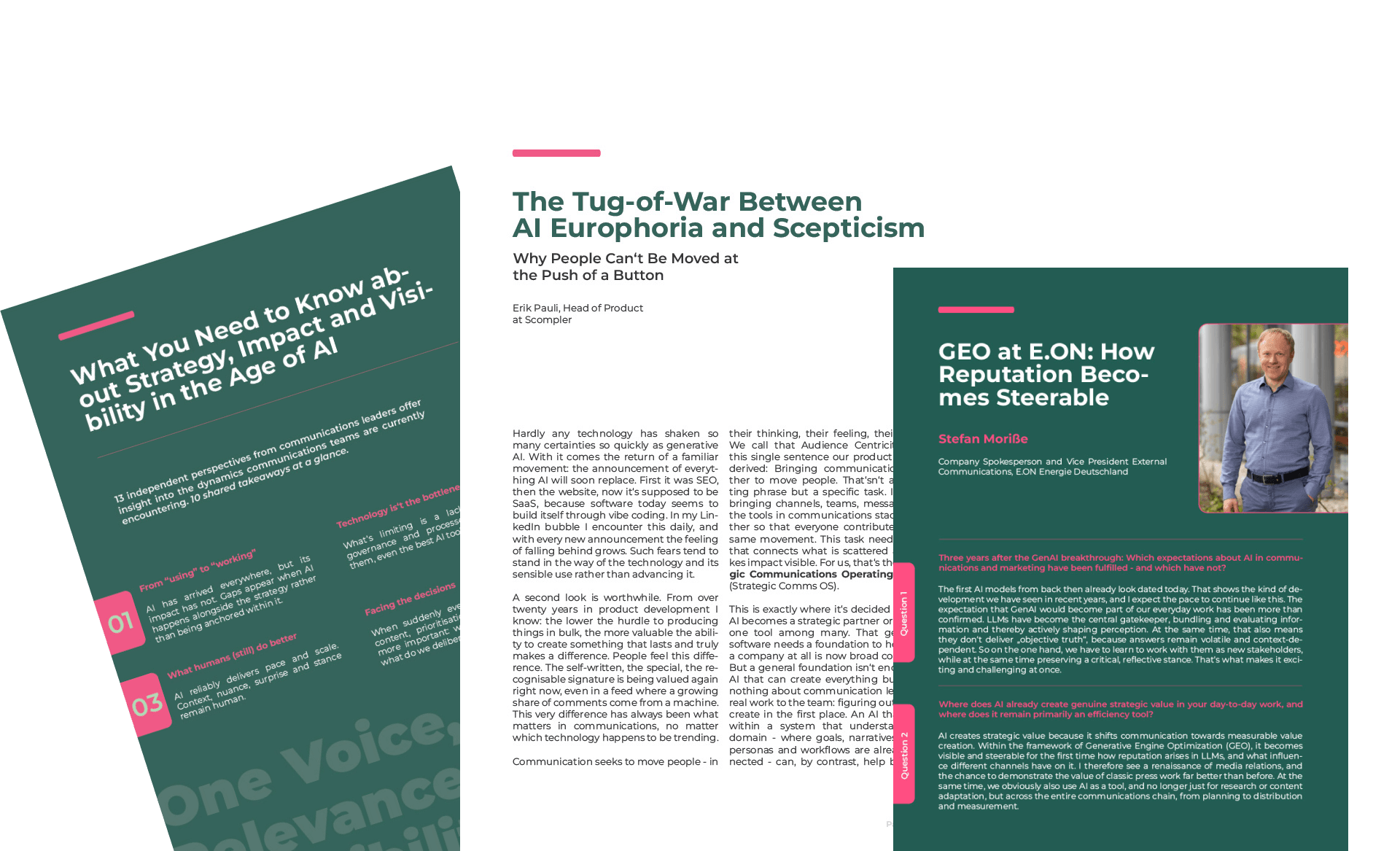
AI as a Strategy Partner: Expert Insights and Guest Contributions in the Whitepaper
- Erik Pauli, Head of Product at Scompler, is integrating AI into Scompler as a Strategic Communications Operating System and demonstrates how organizations can use it to build a well-founded topic architecture in just a few hours.
- Tereza Urbankova, Senior Media Relations Manager at Boehringer Ingelheim, explains why AI still falls short when it comes to context, nuance, and stakeholder dynamics, and which tasks her media relations team has now outsourced to AI.
- Hannah Czekal, Corporate Communications Manager at Giesecke+Devrient, makes it clear that the real bottleneck is not the technology, but rather data, governance, processes, and prompt skills.
- Timm Rotter and Katja Hertin of In A Nutshell present an early warning system: four warning signs of irrelevance in the AI era, each accompanied by a practical test and a countermeasure.
- Laurent Turpault, Director of Corporate Affairs at Heineken France, explains why an AI gimmick (voice cloning) was scrapped-and what that teaches us about authenticity in C-level communication.
- Julian Stutz, Head of Cross-Media at Die Magaziniker, explains how AI is changing strategic storytelling and shares why this creates not a problem with creativity, but rather a problem with decision-making.
- Anton Tsuji, co-founder of clusterfck consulting, warns of the resurgence of “fear of the blank page” and the skills gap caused by the elimination of entry-level tasks.
- Maximilian Miguletz, Director of Strategic Communications at Scompler, debunks (at least in part) the GEO hype and explains why AI visibility is about the substantive content of communication.
- Stefan Moriße, VP of External Communications at E.ON Energie Deutschland, describes how reputation can be managed through Generative Engine Optimization.
- Katrin Kempe and Lili Frankus, founders of duwerk, use the AI Search Report 2026 to show why the entire ecosystem determines AI visibility-including a practical, instant GEO check.
Scompler AI: Your New Strategy Partner
Discover the features and benefits of our new Scompler AI -including Q and A with pricing, privacy, and a free trial period.
AI in Communications: From Tool to System
If technology isn’t the bottleneck, then it’s the question of what it’s built on. Hannah Czekal of Giesecke+Devrient specifically identifies the limiting factors: data, governance, processes, and prompt-related skills. Without these fundamentals, even the best models won’t create sustainable added value in corporate communications.
"An AI that can create anything but knows nothing about communication still leaves the actual work to the team," says Erik Pauli, Head of Product at Scompler. Only when it operates within a system that integrates goals, narratives, topics, personas, and workflows can AI actively contribute to the communication strategy itself.
"This changes a phrase I've heard in conversations over the years: 'There's no time for strategic communication.' Strategic communication must no longer be a matter of time. Once that's taken care of, the only thing that matters is attitude-and you can't just 'vibe-code' that."
Erik Pauli, Head of Product at Scompler

What is the "great leveling," and how can I recognize it?
About half of all articles on the web are now written by AI; on LinkedIn, according to In A Nutshell, up to 80% of comments posted in the first five minutes are generated by machines. Timm Rotter and Katja Hertin’s point: The very same AI that teams use to compete for attention is causing them to lose it, because interchangeable text doesn’t keep readers engaged. One of their practical tests on this is disarming: Place four anonymized social media posts side by side-two of your own and two from competitors-and have the team guess which ones are yours. Anyone who doesn’t recognize their own has just experienced the leveling effect firsthand. In the white paper, they provide four such warning signs-each with a practical test and a countermeasure.
- Interchangeable Language: Once-distinct brand voices are becoming generic, and AI fed with AI-generated output produces increasingly shallow content with each iteration.
- Strategic Blindness: The easier it is to create content, the less likely people are to ask why that content should exist in the first place.
- Impaired judgment: AI-generated texts that sound authoritative often prevent communications professionals from critically evaluating suggestions
- Visible but not discoverable: Content is optimized for an SEO landscape that no longer exists, while AI systems read, summarize, and cite only individual sources.
"We don't have a creativity problem. We have a decision-making problem."
Today, AI generates ideas, phrasing, and variations every second-which is precisely why, according to Julian Stutz of Die Magaziniker, the bottleneck is shifting from production to evaluation.
Which topics are truly relevant? Which messages contribute to our goals? And what are we consciously choosing not to include?
The conceptual framework behind this-which Scompler also supports-is simple: Strategy → topic → Story → Post: The strategy defines what a brand stands for; from this, topics are derived; stories bring them to life; and individual posts each tell a part of that story. People remember stories that surprise them and demonstrate a stance, according to Stutz, and those stories don’t emerge where AI dictates the most likely scenario.
Why AI Visibility Rewards Those Who Have Always Been Good at Communicating
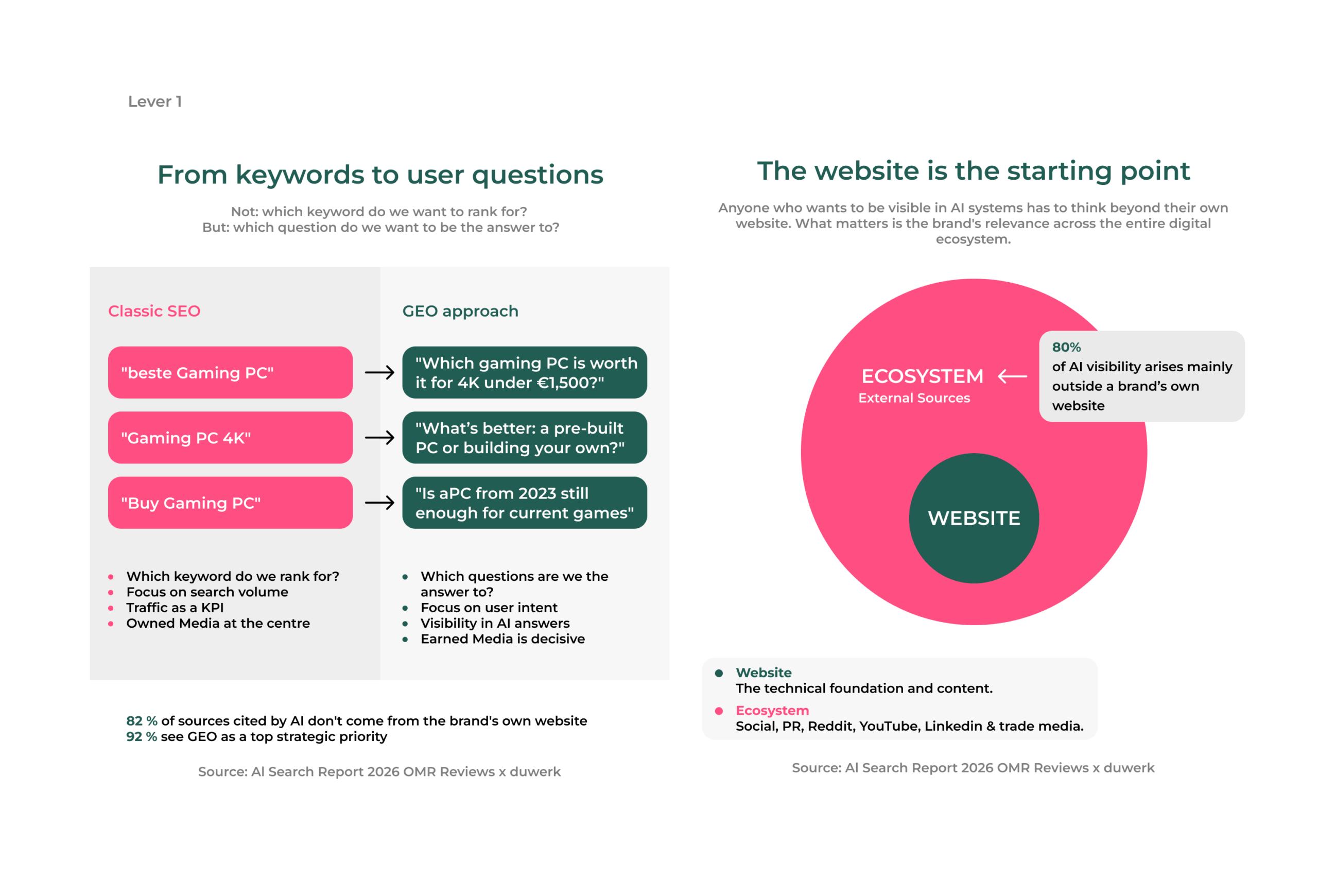
Generative Engine Optimization (GEO) describes how brands can become visible and quotable in the responses of AI systems such as ChatGPT, Gemini, and Claude. Brands that don’t appear in these responses won’t reach people at all.
In his article, Maximilian Miguletz, Director of Strategic Communications at Scompler, cites several studies showing that many GEO tactics have no effect at all-or only a random one. What does have a positive effect on AI visibility, however, is nothing new. Thematic relevance, consistent messaging, and rigorous quality standards have always been the hallmarks of good strategic communication.
In their AI Search Report 2026, Katrin Kempe and Lili Frankus of duwerk further demonstrate that the race for AI visibility largely takes place on platforms that do not belong to a brand, and they provide a six-question GEO Quick Check.
How is AI evolving from a writing assistant to a strategic partner?
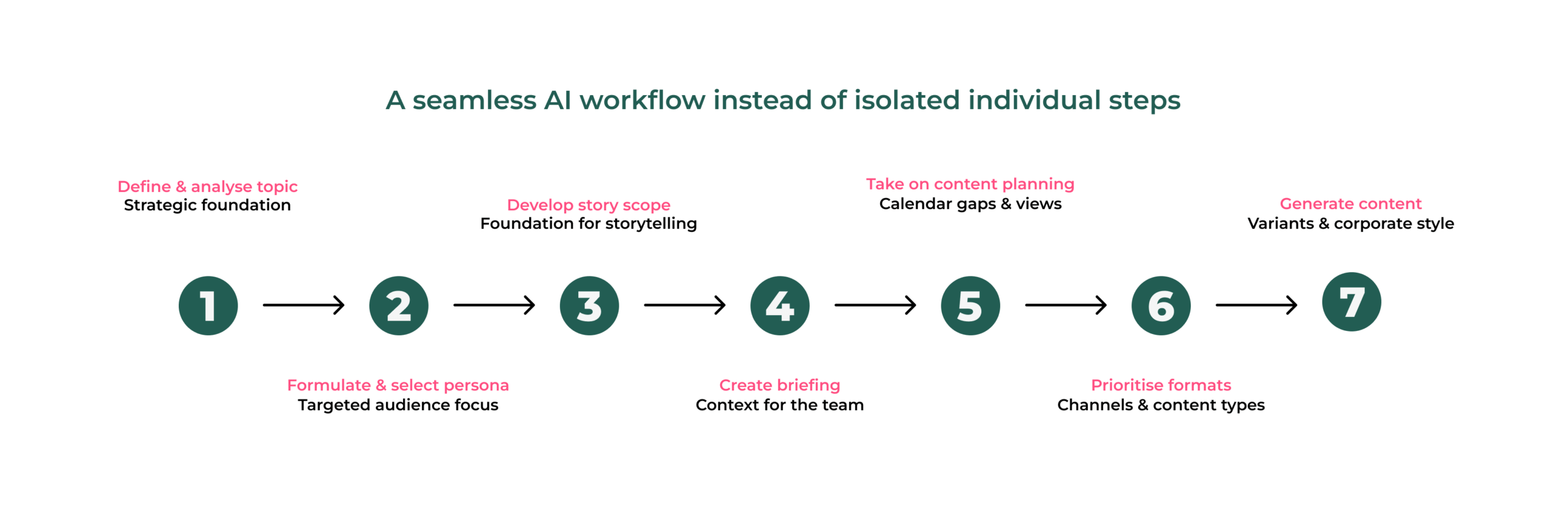
The Scompler AI application demonstrates how AI truly functions as a strategic partner. A Scompler AI beta tester built a complete topic architecture in an empty Scompler project in about two hours-including strategy attributes, topic areas, topics , and personas-drawn from the tester’s own briefings, internal sources, and the web.
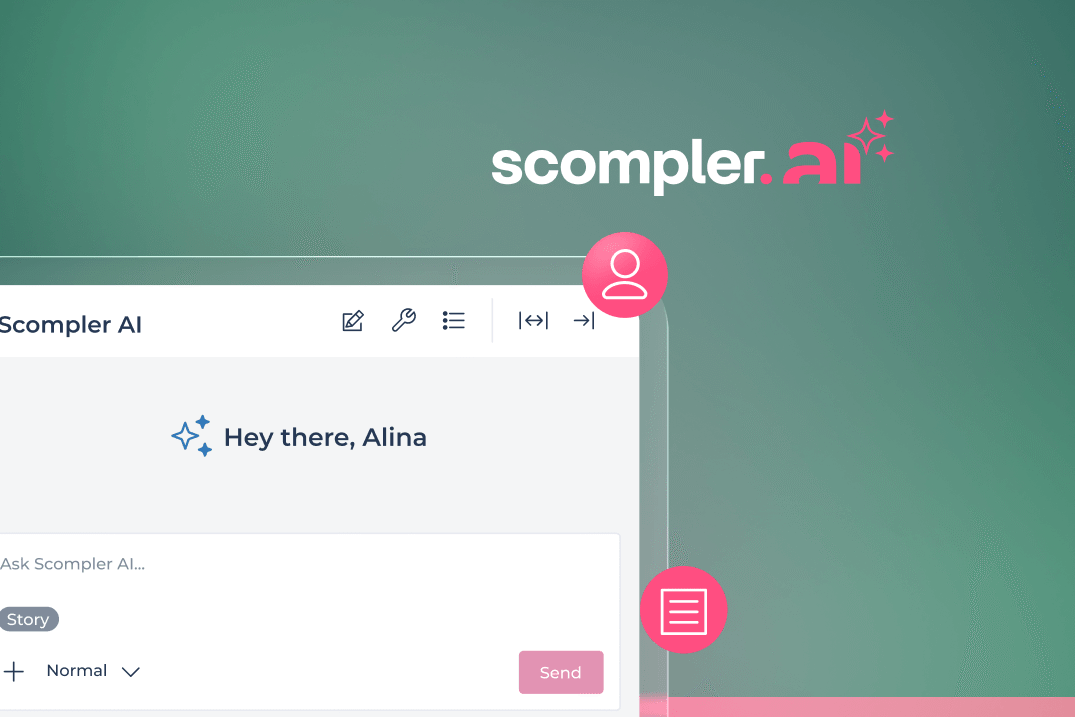
Scompler AI not only understands topics, personas, goals, and narratives, but also analyzes how these elements interact, identifies gaps in your communication strategy, and suggests specific improvements. Editorial control always remains with you: Scompler AI reviews, structures, and recommends-you decide which suggestions to adopt, adapt, or reject. You can find use cases and benefits directly in the whitepaper.