




AI in Corporate Communications: The Intelligence Behind Genuine Impact
Why Communication Is Becoming More Complicated, Even Though AI Promises Efficiency
The world is moving faster and faster. Our attention span is shrinking to the duration of a swipe to the next video dopamine hit. Technology and AI promise efficiency, automation, and less complexity—even in corporate communications. And yet I feel like communication is getting more and more complicated.We’ve introduced processes just for the sake of having processes. We’ve adopted frameworks that were supposed to help us, but often end up creating new coordination loops. And sometimes I catch myself wondering: Are we managing this because it adds value—or simply because that’s how we’ve always done it?
AI in Corporate Communications: A Case of Déjà Vu from Software Development
I’m familiar with this pattern from software development. Agile frameworks like Scrum have a solid foundation: working iteratively, learning quickly, and delivering value. But what often happens is that teams follow the playbook to the letter, performing rituals just for the sake of it—and don’t even realize that they’re paralyzing themselves. The framework becomes an end in itself.
I’m currently observing a similar phenomenon in the communications industry. The corporate newsroom, as a framework for collaborative work, has a solid foundation: creating structure, breaking down silos, and thinking in an integrated way. But in practice, it has often been reduced to rules, guidelines, idealistic perspectives, and the dogmatism of following only one “golden path.” This has manifested, for example, in an obsessive focus on specific topics while simultaneously demonizing channel-centric approaches. The result: Many companies have gotten bogged down on the path to change management before they’ve even reached their destination.
And now we’re seeing the same thing happen with AI. Many companies are rushing to adopt the technology without clarifying what they actually want to achieve strategically. AI is becoming the next framework to be implemented—rather than a tool to amplify an already clear strategy. Studies show that many AI projects fail not because of the technology itself, but because of a lack of strategic foundation. AI cannot resolve complexity; it merely amplifies what’s already there. If the strategy is unclear, the AI output will be unclear as well. This brings us back to the original question: So, should we reduce complexity? Back to the basics.
The European Communication Monitor (ECM) 2025/26 describes communication professionals as people who are in the eye of the storm. It emphasizes that the central challenge lies not in content production, but in maintaining the company’s positioning and using strategic foresight to overcome cross-generational challenges.
That sounds very much like an attempt to stay on course in the eye of the storm. Let's set aside the complexity, the various scenarios, and all the interdependencies for a moment and consider what the common ground is.
"The Actual Narrative is what our target audience currently believes, perceives, and thinks of us. The Target Narrative is what we want to achieve—in other words, how would we like to be perceived, and how should our brand be understood?"
Erik Pauli, Head of Product, Scompler
Why do we actually communicate?
Simply put: to move people from A to B—in their thinking, their feelings, and their actions. Everything else—such as topics, channels, processes, and tools—are means to achieve this goal. Nothing more, nothing less. When we think from this core principle, our perspective on what should be at the center of our thinking changes fundamentally.

Audience Centricity: The Real Shift
The crucial question isn’t, “What topics s do we communicate?” but rather, “Where does our target audience stand today—and where do we want to move them?” I call this the shift from the Actual Narrative to the Target Narrative. The Actual Narrative is what our target audience currently believes, perceives, and thinks of us. The Target Narrative is what we want to achieve—in other words, how do we want to be perceived, and how should our brand be understood? So it’s all about the space in between: the Narrative Gap. It defines the communication challenge: moving people from the Actual Narrative (A) to the Target Narrative (B).
topics, Channels, formats—all of these remain important. But their role is changing: from a strategic starting point to a framework for implementation. They are the tools we use to orchestrate the audience’s narrative journey in a targeted, measurable, and effective way. The starting point of audience-centricity, however, is the target audience and the response we want to trigger in them. This not only enables measurable, controllable communication—it also secures communication teams their seat at the table.
Professor Ansgar Zerfaß describes integrated communication in terms of four dimensions: content, processes, structures, and objectives. All of these must be coordinated. Professor Dr. Christopher Storck describes strategic communication as planning that begins with the corporate goal: Communication activities must be strictly aligned with the strategy by first defining their contribution to a corporate goal and then working backward from there through the necessary stakeholder actions to messages and measures. Both perspectives lead to the same conclusion: Communication requires a system that effectively connects these elements.
The Vision: Strategic Communications Operating System
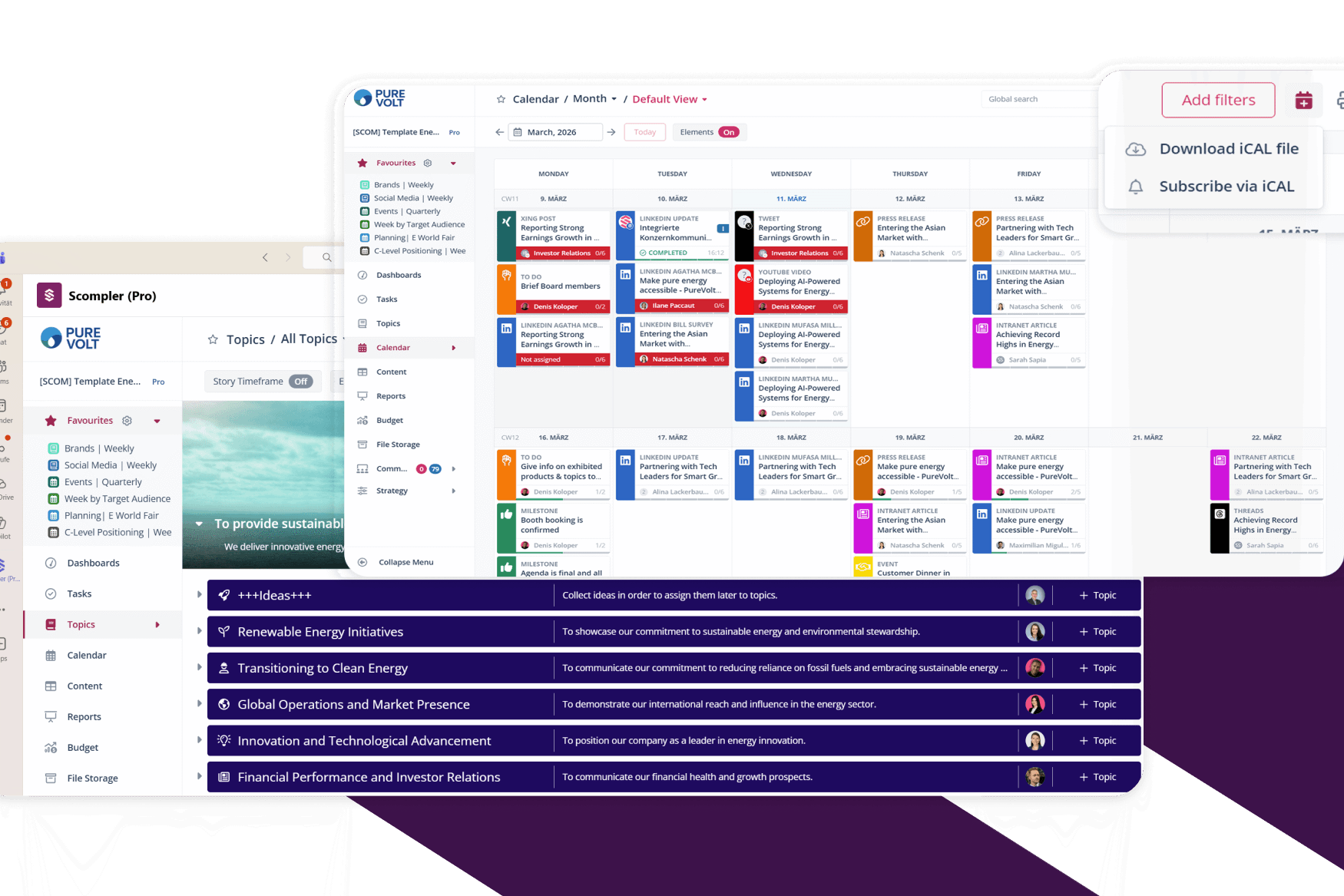
At Scompler, we’re working on exactly this system. We call it the Strategic Communications Operating System—an interconnected, intelligent layer that transforms communication into measurable business impact. The reality is complex: Not every audience is interested in every topic. Not every message works on every channel. topics Using a “spray and pray” approach to spread messages across all channels doesn’t generate engagement—it just creates noise. What does it take to address these challenges and make our vision a reality?
Four building blocks:
- Audience Centricity as a Foundation: Communication that begins with the target audience and uses the narrative gap as a strategic starting point. The core narrative and strategic goals for the audience (contextual variation) help set the target and design the plan to reach it using the right topics, stories, and formats.
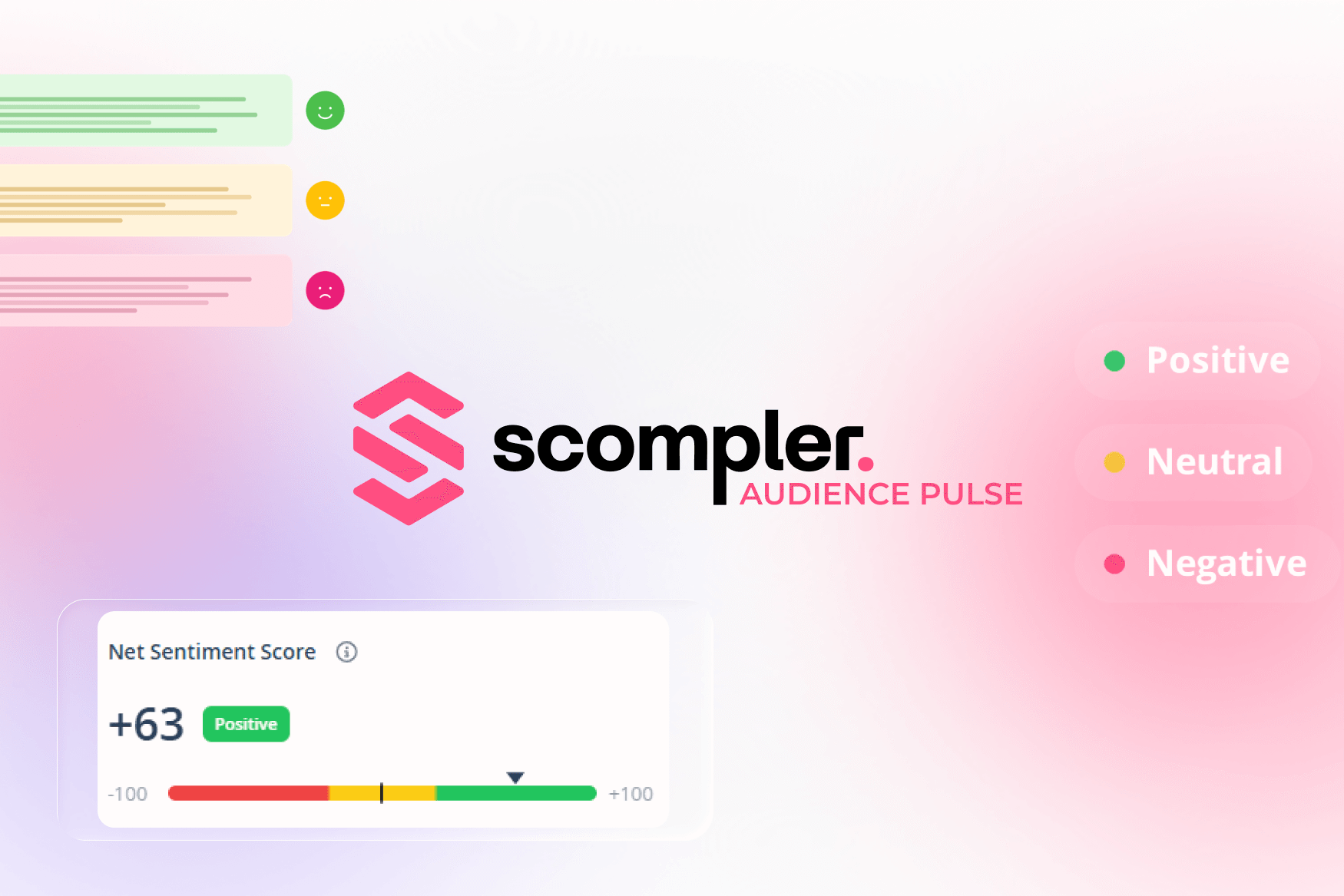
- Narrative Intelligence as a Compass: The ability not only to measure what is published, but also to understand how it is received and whether you are on the right track to achieve the desired response from the target audience. Among other factors, sentiment, perception, and audience signals, interpreted in the context of strategic goals, play an important role here.
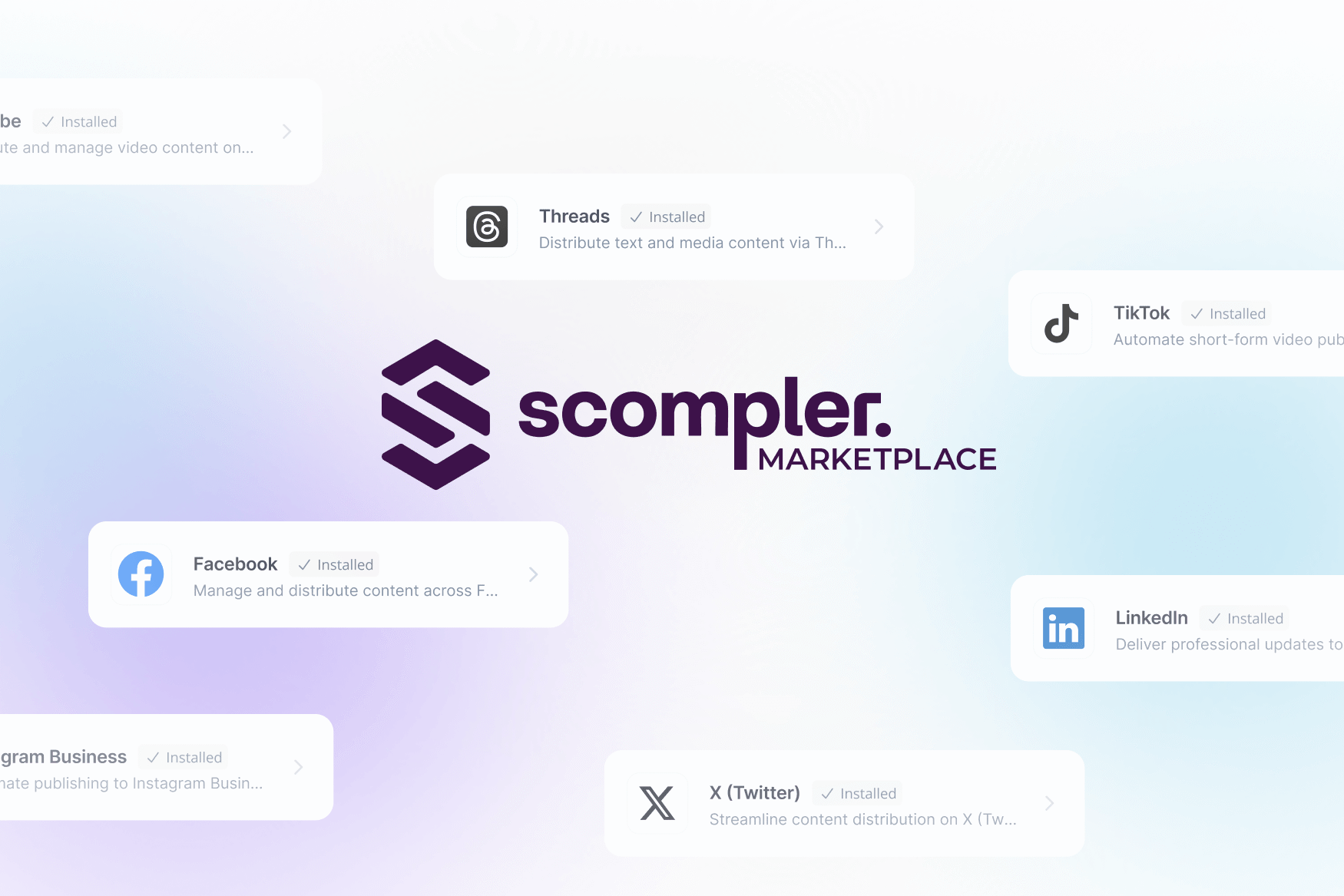
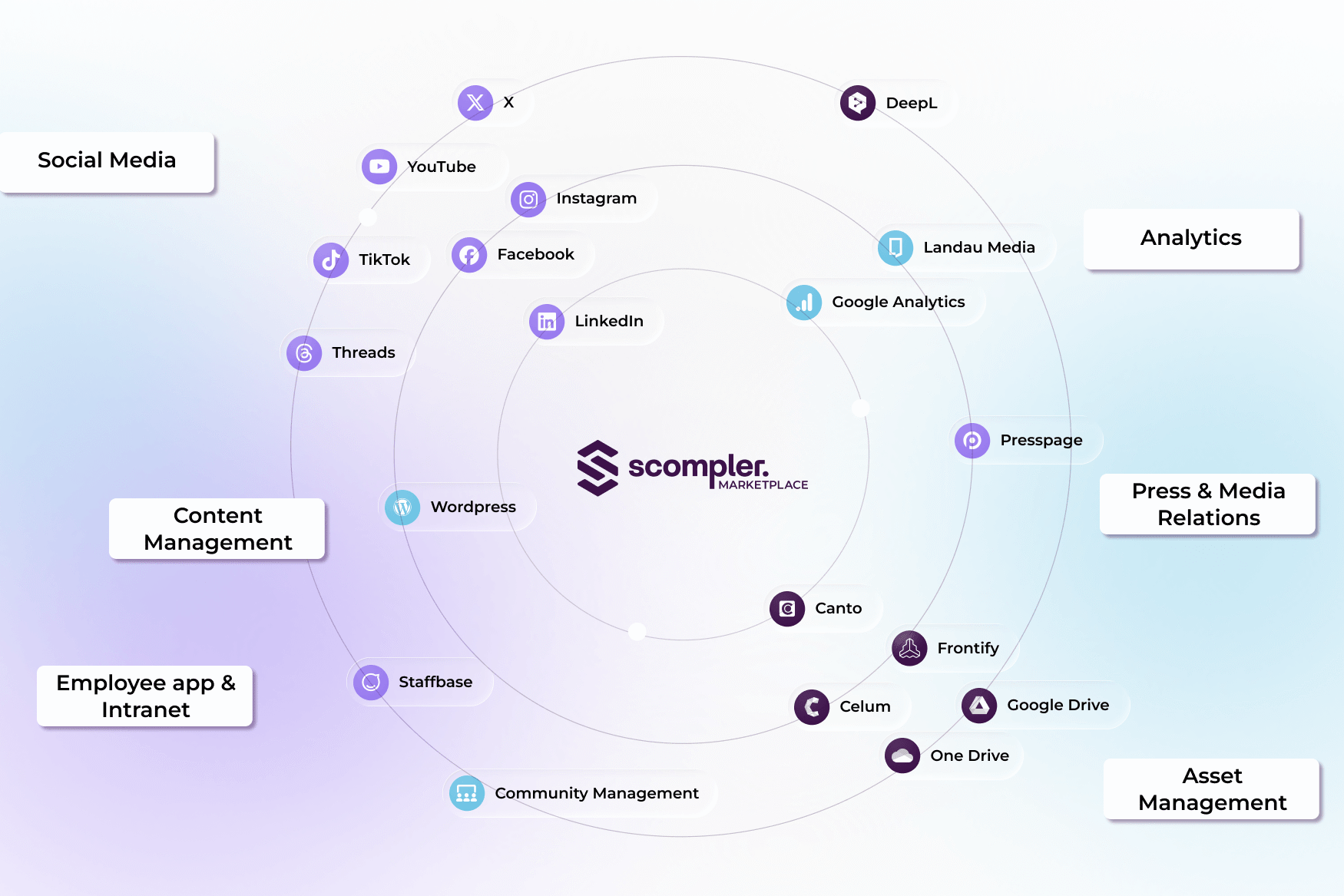
- Connected Intelligence as an Ecosystem: Existing tools in the communications system can be connected via open APIs and the Marketplace. The Scompler platform serves as the orchestration layer, bringing strategic coherence to every system—whether it’s a channel, asset management, or analytics system.
- Agentic Intelligence and automation as the backbone of communication workflows: Agents handle routine tasks and ensure smooth processes, while humans retain control. This guarantees efficiency and strategic focus in every AI-supported task, giving teams the freedom to tell inspiring stories.
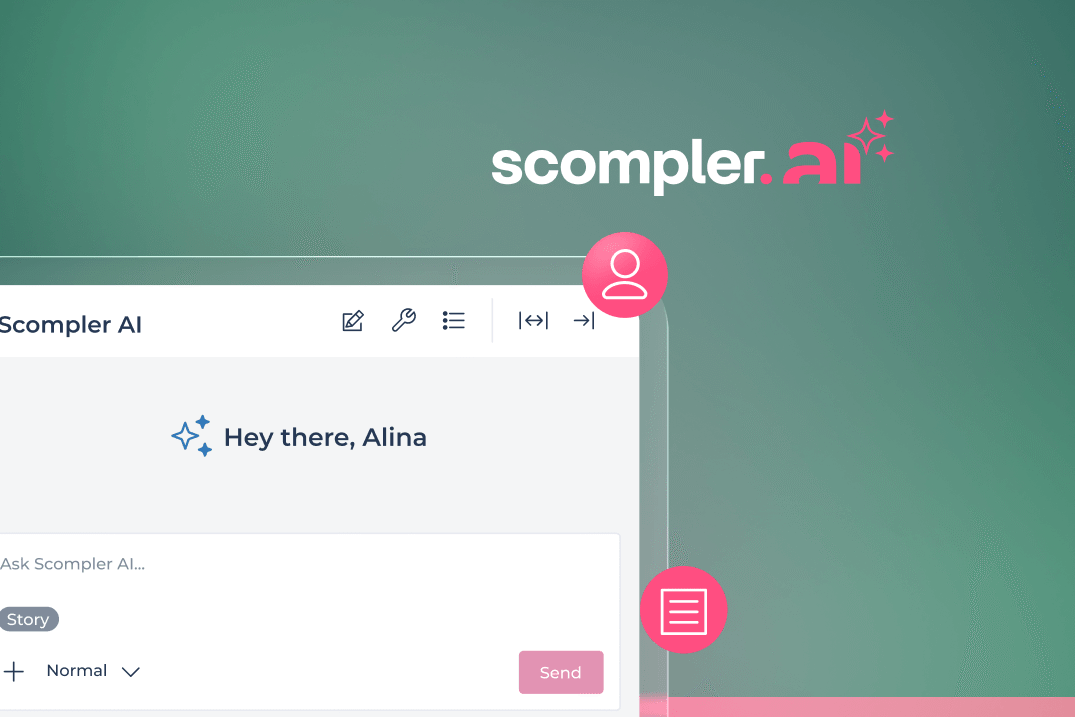
In our vision, AI is therefore a fundamental component that enhances strategic clarity, not a substitute for it. Scompler AI is the first technology to technically implement this principle. It suggests stories not based on trends, but based on their suitability for supporting the strategic path mapped out in Scompler. The result is communication that is not only published but also actually has an impact.
AI in Corporate Communications: Join Us in Building the Strategic Comms OS
There is no one-size-fits-all solution. But there is a clear path—away from framework dogmatism and toward a system that takes the essence of communication seriously. The Strategic Communications Operating System is not a distant vision. It is an architecture that we are building step by step, together with our clients, communications experts, industry pioneers, and innovators. Because in the end, it’s about what communication has always been about: moving people.
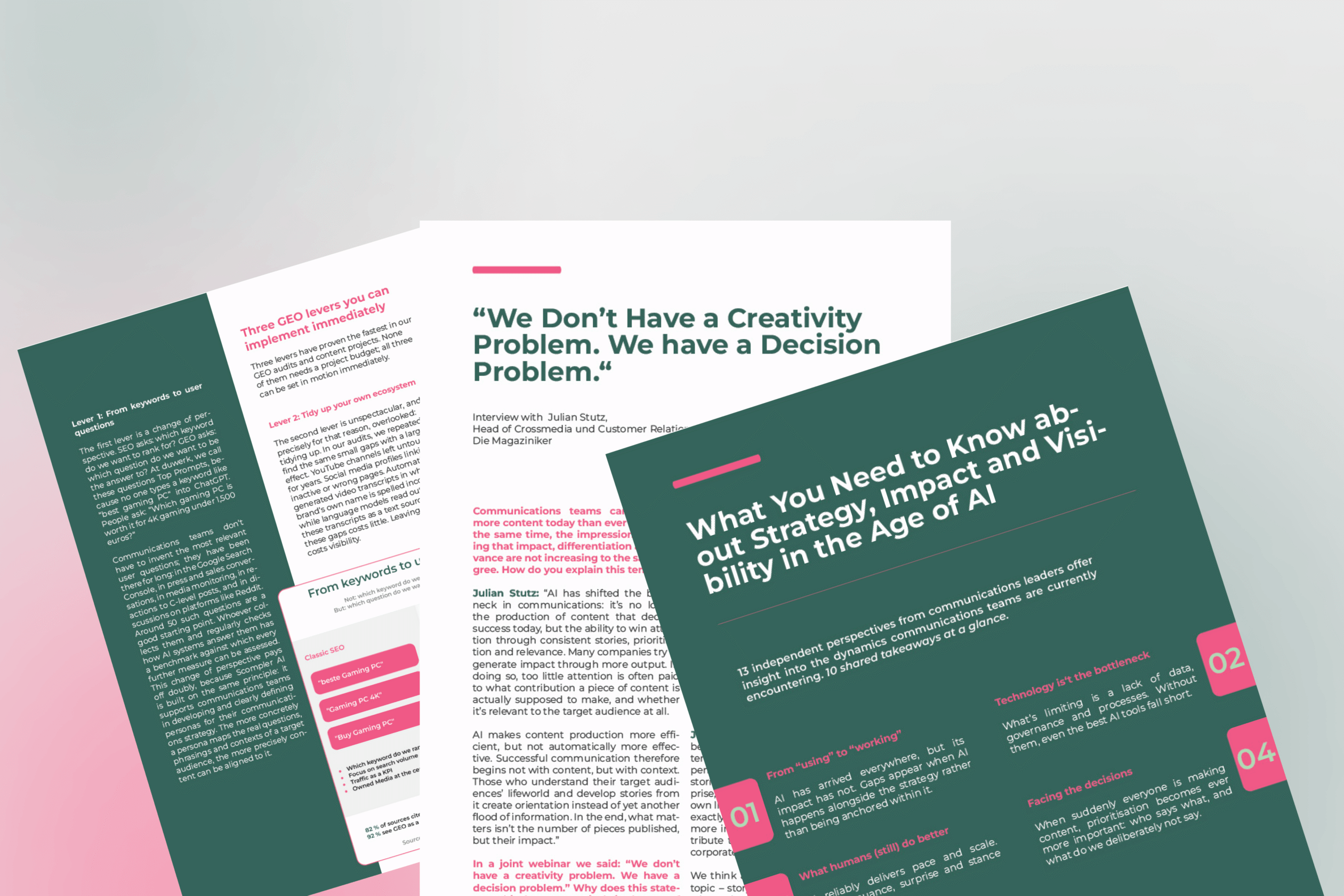
This text first appeared in the white paper “Strategic Communication and AI, ” published by Scompler in December 2025.